 NVDL
NVDL targets twice NVIDIA’s daily performance, while NVD targets negative twice its daily performance. Those opposite daily objectives do not guarantee equal and opposite results over your holding period, and neither fund is a permanent hedge against the other.
Ticker precision matters. GraniteShares’ NVD is a daily −2x product in its October 28, 2026 document. Direxion’s NVDD is a different product with a daily −1x objective. Calling every NVIDIA bear ETF “2x short” would misstate the exposure before the trade even begins.
Compare the current objectives first
The NVDL summary and NVD summary prospectus identify the underlying company as NVIDIA. Their intended directions differ, but both use a daily measurement framework rather than a fixed multiple of a month’s stock return.
The NVD document’s filename contains an old-looking date; its cover identifies October 28, 2026. Read the actual document date and amendments rather than assuming the address describes its current contents. Likewise, do not substitute a fund’s original launch objective for its current target.
| Instrument | Intended daily exposure | Basic directional view |
|---|---|---|
| NVDL | +2x NVDA | Benefits in the simplified model when NVDA rises |
| NVD | −2x NVDA | Benefits in the simplified model when NVDA falls |
| NVDD | −1x NVDA | Different inverse magnitude; not equivalent to NVD |
The Direxion NVIDIA product page is the primary reference for NVDD’s target. Comparing names without these numbers can produce an unintended position size or hedge ratio.
Follow the direction through one matched day
In a simplified close-to-close model, a +4% NVIDIA day produces +8% for the daily bull exposure and −8% for the daily −2x bear exposure. A −4% stock day reverses those signs. These are target-based illustrations before costs, tracking effects and market-price differences.
The direction of risk is therefore opposite. A favorable product announcement or other bullish catalyst can hurt NVD; disappointing news can hurt NVDL. Buying shares of an inverse fund does not mean the account has borrowed NVIDIA shares directly, but the fund’s derivatives and reset process still create substantial risk.
Your own intraday entry may not coincide with the start of the fund’s daily interval. Avoid treating the table as a guaranteed multiplier on the NVIDIA change shown since your purchase. The price you pay and the next price available to exit also matter.
See why both funds can lose over two days
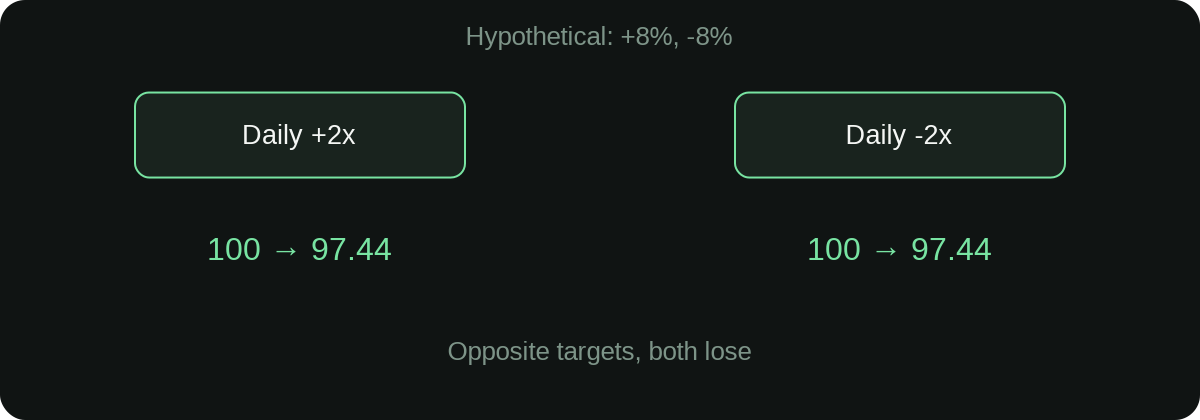
Consider an entirely hypothetical NVIDIA path of +8% followed by −8%. The stock index starts at 100 and ends at 99.36. An idealized daily +2x fund follows 100 × 1.16 × 0.84, finishing at 97.44.
An idealized daily −2x fund follows 100 × 0.84 × 1.16 and also finishes at 97.44. Both leveraged paths lose 2.56% in this example, even though their daily directional targets are opposite. Costs would introduce additional differences from these simplified values.
| Model, starting at 100 | After day one | After day two |
|---|---|---|
| NVIDIA | 108.00 | 99.36 |
| Daily +2x | 116.00 | 97.44 |
| Daily −2x | 84.00 | 97.44 |
The lesson is not that the funds always lose together. A persistent trend produces different outcomes. It is that a reversal changes the bases on which subsequent percentage gains and losses operate; opposite daily targets do not cancel that arithmetic over time.
Evaluate a hedge in dollars and over a defined interval
If the purpose is to offset an existing NVIDIA-sensitive holding, define what is being hedged, its dollar exposure and the intended time window. A portfolio containing options, other technology stocks or several ETFs will not have a constant one-for-one relationship with NVDA.
Even a simple NVDA holding changes value while an inverse fund resets its own exposure. A hedge proportion chosen at one close can drift. A position that is approximately offset for one modeled daily move may become overhedged or underhedged after subsequent moves.
Holding equal dollars of NVDL and NVD is not a free way to preserve capital or collect volatility. The two-day calculation shows one failure mode, and expenses and execution can add others. The SEC’s single-stock ETF explanation describes the concentration and complexity that remain beneath the ETF wrapper.
Compare costs and execution separately from direction
Before choosing either fund, read its own current fee table, financing disclosures and trading conditions. Similar issuer branding does not establish identical expenses. No current NVD cost ranking is claimed here, and a management fee alone would be an incomplete comparison.
Inspect the bid, ask and available size for the particular ticker. NVDL’s trading activity does not establish NVD’s liquidity. An available regular-session quote does not prove overnight eligibility for either security at your broker.
If switching from bull to bear, confirm the first position’s actual execution and any residual shares. Two pending instructions can leave overlapping exposure. Record the reason for the switch so a response to new evidence is distinguishable from repeatedly reversing after losses.
Decide whether the directional tool fits the job
NVDL and NVD express different short-horizon views using daily leverage. Neither becomes an ordinary long-term NVIDIA investment because it is purchased as an ETF share. If the task is business ownership, compare direct shares; if it is a hedge, evaluate the complete portfolio and the reset mismatch.
The multi-day mathematics can help check a proposed path. It cannot determine which direction the next stock move will take. Choosing the correct sign is only one part of evaluating the trade’s potential loss, costs and operating constraints.
Frequently asked questions
Does buying NVD require me to locate NVIDIA shares to borrow?
A normal purchase of ETF shares is not a personal short sale of NVDA. Account permissions and financing terms still apply, and the inverse fund’s internal structure creates risks of its own. Short-selling the ETF would be a different transaction.
Can NVD rise when NVIDIA is up over an unusual comparison window?
A mismatched interval, market-price premium or discount, distribution adjustment or data issue can complicate the comparison. First align timestamps and return definitions before interpreting a result as a failure of the stated daily objective.
Is a short ETF the same as buying a put option?
No. A put has an expiration, strike and option-pricing sensitivities. An inverse ETF has its own daily reset and operating costs. Neither is a universal substitute for the other, and a payoff comparison needs explicit assumptions.