 NVDL
To analyze a Fed event for NVDL, distinguish the policy decision from later minutes, speeches and economic reports. Identify what became newly public and when, then measure the relevant market window. A document about an earlier meeting is not automatically a new rate change.
This guide builds an event record for a technology-linked daily leveraged ETF. The separate interest-rate article explains valuation and financing channels. Here the task is to avoid trading or publishing a narrative based on the wrong event, timestamp or comparison.
Label the document before interpreting the headline
A policy statement communicates a decision and its accompanying explanation. Meeting minutes provide a later account of the discussion. A press conference can add context, while a speech can express an individual official’s assessment. Those communications have different authority and timing.
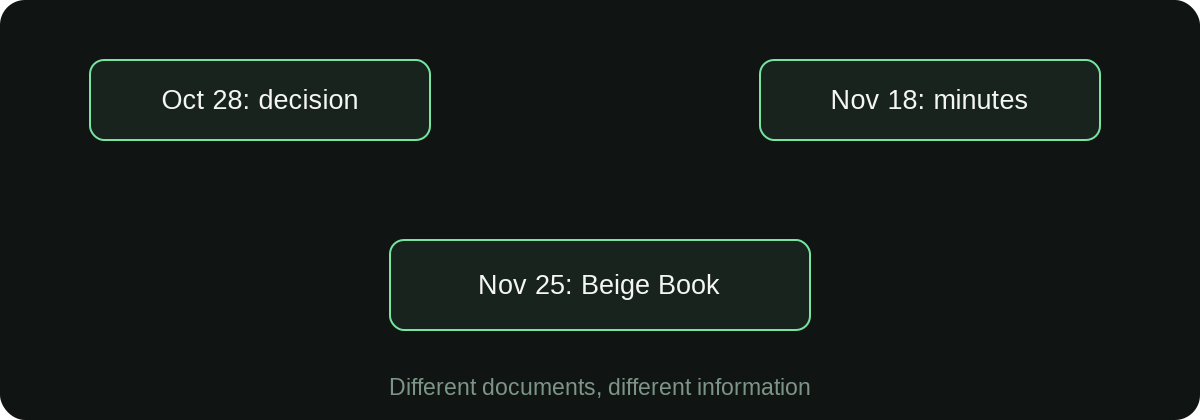
The Fed’s October 28, 2026 statement maintained the federal funds target range at 3.75%–4.00%. The official November calendar lists the October meeting’s minutes for November 18 at 2 p.m. and the Beige Book for November 25 at 2 p.m.
These are separate events. The November 24 publication of discount-rate meeting minutes is another document type, not evidence of a new November 24 FOMC target decision. A headline containing “Fed” and “rates” does not resolve that distinction.
Create the event row before opening the chart
Record the issuing body, document type, meeting period, publication date, original time zone and link. Then note the exact information being studied. A broad label such as “Fed day” can hide several releases with different market implications.
For a prospective record, distinguish a scheduled time from confirmation that the material was actually public. For a retrospective study, preserve the first public timestamp where available. A news article’s later update time should not silently replace it.
| Event field | Example of the question it answers |
|---|---|
| Document type | Was this a decision, discussion record or economic survey? |
| Meeting or data period | Which earlier activity does the publication describe? |
| Public release time | When could the information enter market pricing? |
| Prior information | What was already known before publication? |
| Study window | Which price interval will be compared? |
Define a surprise against prior evidence
A market response depends partly on what participants expected before the event. A rate hold can be unsurprising, while the explanation or projected path can change expectations materially. The size of the decision alone does not measure its surprise.
Use a dated expectation source with a clear methodology if making a probability or surprise claim. This guide does not reconstruct an exact pre-event consensus or publish an unsupported numerical surprise. A commentary written afterward cannot establish what all traders expected beforehand.
Keep policy expectations separate from investment forecasts. Even a well-measured policy surprise does not uniquely determine NVIDIA’s share-price response. Company news, valuation and broad market positioning can enter the same interval.
Match the event window to the security data
Select the interval before choosing the most dramatic price movement. A narrow window can focus on immediate repricing but requires reliable timestamped observations. A close-to-close window is easier to describe but includes more potentially competing information.
Use compatible NVDA and NVDL data, specifying sessions and adjustment conventions. Do not compare a regular-session stock close with an extended-hours ETF print and describe the difference as tracking failure. Quotes and completed trades are different observations as well.
NVDL’s daily objective applies to a defined stock-return period, not to the length of a press conference. An intraday reaction from a chosen pre-release point is not guaranteed to receive exactly the same multiplier. The investor’s own entry and exit prices create another interval.
Check competing catalysts before assigning a cause
Create a parallel timeline for NVIDIA earnings, filings and other material announcements. Broad technology and semiconductor news can overlap with a policy event. If several plausible drivers share the window, a single-cause headline is stronger than the available evidence.
NVIDIA’s November earnings release and subsequent leadership announcement are examples of separate company events in the same month. Their existence does not establish that they affected every Fed-related trading interval, but it shows why a clean event inventory matters.
Do not infer order-book conditions, forced liquidations or institutional positioning from the price chart alone. Those claims require their own data. A fall following a statement establishes timing; it does not automatically identify who traded or the exact mechanism behind the move.
Separate an event study from an order plan
An event study asks what the observed market data shows. An order plan asks how the account will participate or exit under actual trading constraints. Correctly identifying a policy development does not guarantee an executable price.
Before carrying exposure through the event, check active order sessions, limits and available monitoring. The SEC’s order-type explanation describes why price constraints and execution priority have different consequences. Gaps or rapidly changing quotes can frustrate a plan even when the macro interpretation is reasonable.
Avoid choosing a large position because the policy outcome appears obvious. The response to the explanation, future path or other news can differ from the response assumed in the thesis. A planned loss amount remains a risk estimate, not an insured limit.
Publish the conclusion at the strength of the evidence
A sound summary identifies the release, what changed, the chosen market window and unresolved competing explanations. If the dataset supports only a daily observation, report that limitation rather than presenting a minute-level causal conclusion.
The SEC leveraged-ETF bulletin adds a separate caution for longer comparisons: daily compounding changes the relationship between the underlying and fund. A multi-day decline after a Fed event cannot be explained solely by doubling a single policy-day stock move.
The useful output is a dated, reproducible event record. It can support better interpretation without becoming a promise that the next meeting will create the same direction, magnitude or opportunity. Policy analysis and market execution remain distinct tasks.
Frequently asked questions
Are all Fed speeches statements of the entire committee?
No. Identify the speaker’s role and the context, and distinguish an individual assessment from a formally adopted committee communication. Do not upgrade a speech into a new collective decision without supporting documentation.
Can a release move markets before its scheduled time?
Prices can change in advance because expectations or other information change. That does not prove the scheduled material was already public. Verify actual publication evidence before making a claim about early access or a leak.
Should I combine several Fed events into one reaction number?
Only with a clearly defined method and window. Combining releases can obscure which information was new and introduce overlapping drivers. Report the aggregation limits rather than attributing the total mechanically to one statement.