 NVDL
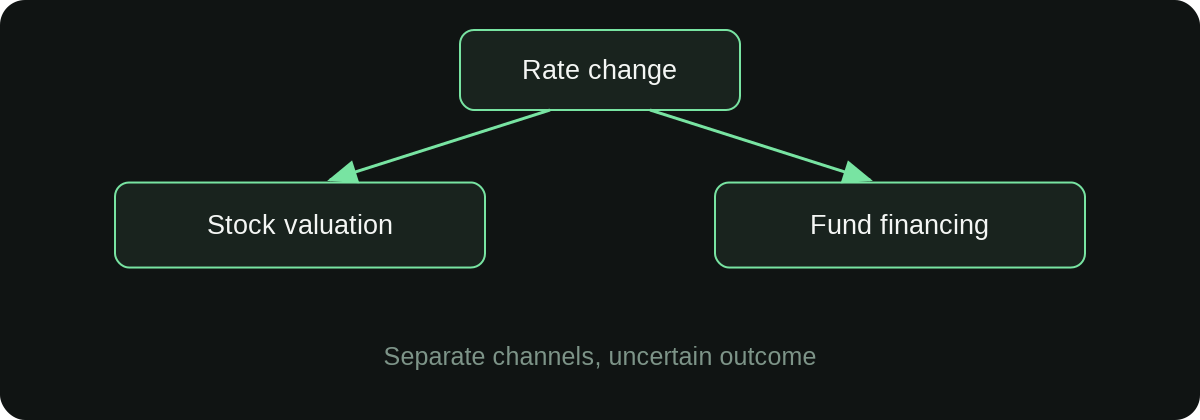
Interest rates can influence NVDL through NVIDIA’s valuation and through the leveraged fund’s financing economics. These channels are related but different, and a Fed rate cut does not mechanically produce an NVDL gain or an equal reduction in every fund cost.
The important question is what changed relative to expectations and how that change reaches the company, the stock and the fund. A policy headline, a Treasury yield and a swap financing term are different measurements. Treating them as one number can lead to an unsupported trading conclusion.
Establish the current policy reference accurately
The Federal Reserve’s October 28, 2026 statement maintained the federal funds target range at 3.75%–4.00%. That is a dated policy decision, not the current yield of every bond or the borrowing rate charged on every investment account.
The implementation material also concerns specific administered rates and market operations. Do not substitute one of those figures for the target range without labeling it. Similarly, the release of meeting minutes later does not mean a new rate decision occurred on the minutes’ publication date.
For any later update, begin with the latest official decision rather than copying this range into a permanently current headline. Record the release date, effective date where relevant and the exact rate being discussed. This prevents an old policy observation from becoming a false live-data claim.
Understand the valuation channel through NVIDIA
A stock price represents the market’s valuation of uncertain future business outcomes. When the rate used to discount those outcomes rises, their present value can decline if other assumptions remain unchanged. In reality, growth expectations, risk premiums and earnings forecasts can change at the same time.
NVIDIA’s stock therefore does not behave like a fixed-duration bond with an unchanging sensitivity. Higher yields can coincide with stronger economic demand, while lower yields can accompany worsening growth expectations. The reason rates move matters as much as the direction.
Use NVIDIA’s latest earnings release to establish the company’s reported period and management commentary. It provides business evidence, not a formula converting a quarter-point policy change into a particular NVDA or NVDL return. A precise sensitivity estimate would require a stated model and supporting data.
Distinguish policy rates from market yields
The Fed sets a policy target, while market yields respond to expectations, inflation compensation, term premiums and other conditions. Investors can reprice a stock before the scheduled decision if they anticipate the announcement.
Consequently, a rate cut can be followed by rising longer-term yields or a negative equity reaction. A decision that matches expectations may matter less than changes in the projected policy path or the explanation accompanying it. A surprise should be evaluated against a documented prior expectation, not reconstructed after the event.
When reviewing an NVDL move, record which yield changed and over what interval. “Rates were up” is too vague if it mixes a short-term policy setting with a ten-year Treasury observation taken at a different time. Timestamp alignment is necessary before discussing causation.
Read financing costs at the fund level
NVDL uses derivatives to pursue leveraged exposure. Financing terms can depend on market rates and contract conditions, but they are not identical to the federal funds target. Counterparty pricing, collateral arrangements and the amount and type of exposure can also matter.
The October 2026 fund disclosure distinguishes operating expenses from separately described estimated swap costs. A change in policy rates does not establish an immediate one-for-one change in either category. The current terms and actual implementation need to be read independently.
Avoid multiplying the target policy rate by two and calling the result the investor’s exact annual cost. That calculation ignores the structure, the assets supporting exposure, changing balances and contractual details. Likewise, do not assume a net expense figure includes every economic cost associated with derivatives.
The fee-table guide explains the disclosed categories and waiver limits. For a retail trade, execution costs and any broker margin interest add another layer beyond fund-level expenses. Buying NVDL with borrowed account funds can introduce financing even though the ETF already contains leverage.
Trace the channels separately in a scenario
Suppose yields fall while NVIDIA’s business expectations remain unchanged. A valuation model might assign a higher present value to future cash flows, but that is a conditional model result, not a guaranteed stock reaction. Investor risk preferences or company-specific news could offset it.
Now consider lower funding rates under a derivative contract that resets on a particular schedule. The fund’s financing economics might improve relative to an otherwise identical higher-rate scenario. That does not mean the ETF’s market price rises if NVIDIA simultaneously declines.
Keep these two statements separate in a worksheet: the assumed effect on stock valuation and the assumed effect on fund implementation. Do not add an unverified financing benefit to a modeled daily return and present the sum as a forecast.
Evaluate a market move without forcing a single explanation
Build a timeline containing the official announcement, relevant yield observations, NVIDIA news and the selected NVDL trading window. Use consistent data conventions and distinguish regular-session prices from extended-hours prints. Other events can share the same interval.
A daily leveraged objective applies to a particular daily stock-return interval, not to the size of a policy surprise. NVDL does not rise twice the percentage decline in interest rates. Over several days, its compounding also prevents a simple long-period multiplier on the resulting NVDA move.
The conclusion may remain conditional: policy repricing was one plausible influence, while company news and broader technology trading also occurred. That is more accurate than assigning an exact percentage of the ETF’s movement to rates without an attribution model or adequate data.
Frequently asked questions
Are interest earned on fund cash and financing expenses the same item?
No. Cash or collateral income and derivative or borrowing costs can arise under different arrangements. Their net effect requires the relevant financial statements and disclosures; a single published cash balance does not reveal it.
Will my broker reduce margin interest immediately after a Fed cut?
Not necessarily. Account rates follow the broker’s schedule, balance tiers and terms. Confirm the effective date and applicable rate directly rather than assuming a policy announcement automatically changes the charge on your account.
Can inflation news affect NVDL without a Fed meeting that day?
Yes. New information can change expectations for future policy, yields and company prospects between meetings. That is a possible transmission channel, not proof that inflation data caused a particular measured ETF move without further evidence.