 NVDL
Track NVIDIA earnings for NVDL through NVIDIA’s official investor-relations announcements, checking the release date, time zone and fiscal period separately. A calendar estimate is not a confirmed event, and strong reported results do not guarantee an NVDL gain.
As of this guide’s November 26, 2026 source check, NVIDIA’s November 17 release is already historical. Calling it “upcoming” would mislead readers. The next report should be added only when its date is confirmed by an appropriate official announcement, rather than by repeating a quarterly pattern.
Build the calendar entry from the original announcement
Start with NVIDIA’s investor-relations site and find the release or event announcement itself. Save the page address, announced date, stated time and whether the item is a results release, conference call or presentation. Those events can have different timestamps.
Write the time in its original zone and convert it to your location explicitly. Eastern Time and Pacific Time are not interchangeable, and daylight-saving changes can alter conversions to countries that use a fixed offset. A calendar application’s local display should not replace the original time reference.
If the announcement is not yet available, mark the date unconfirmed. Do not publish an estimated next earnings day as a firm appointment, and do not imply that an NVDL order will have access to whatever session contains the release.
Separate fiscal labels from calendar dates
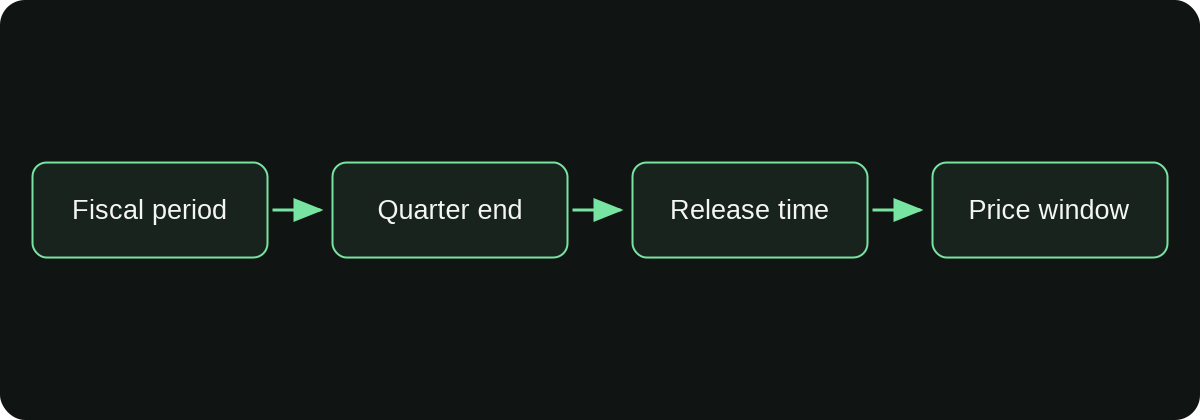
An earnings headline can refer to a fiscal year that differs from the current calendar year. NVIDIA’s November 17, 2026 results concern the third quarter of fiscal 2027, with the quarter ending October 25, 2026. Neither fiscal 2027 nor the quarter-end date is the release date.
Use a record with four fields: fiscal period, period end, publication date and actual public-release time. This avoids placing the event on the wrong chart candle or treating a quarter-end accounting date as the moment investors learned the numbers.
For an archive page, retain those fields instead of replacing all of them with “updated today.” A fresh editorial date does not make an old earnings figure current-quarter data. It also does not prove that a forecast made before publication anticipated the result.
Read the release in layers
Begin with the reported period and any accompanying guidance. Then inspect segment performance, margins, cash generation and limitations in the company’s explanations. Preserve the difference between what was reported and what management expects to happen later.
The latest verified release provides an actual document to read, but this guide does not establish a dated analyst-consensus baseline. Consequently, it does not label the numbers an earnings beat or miss. Such a label requires comparable expectations captured before the announcement and consistent accounting definitions.
Keep GAAP and non-GAAP measures distinct. If discussing a change in profitability, compare the same measure across the relevant periods. A headline revenue increase alone cannot establish that every margin, customer concentration or valuation concern has improved.
Plan for the release window, not a promised direction
Before a scheduled report, identify whether your position would remain open when results become public. Review the broker’s NVDL-specific session access and the actual operating hours of existing stops or limits. A daytime exit instruction may not trigger during an after-hours announcement.
Write down how you would respond to missing data, a trading interruption or a gap past the intended exit. The purpose is to identify operational constraints before the event, not to predict a precise reaction. A lower position size reduces dollar exposure but cannot guarantee an acceptable execution price.
NVDL’s prospectus defines its leveraged objective over a daily measurement period. An earnings reaction measured from one after-hours print to another is not automatically that period. Multiplying an arbitrary NVIDIA headline move by two can misdescribe what the ETF or your own trade actually earned.
Measure a reaction only after defining the window
Choose the question before choosing the prices. You might examine the first regular-session close after the release, or the change between the last pre-release close and a specified later close. Each window answers a different question and can include other news.
Use consistent adjusted-price conventions for the two securities and identify whether distributions are included. Record the source and delay. If reliable intraday data is unavailable, narrow the claim to the interval you can measure instead of manufacturing a minute-by-minute narrative.
A simultaneous movement does not isolate causation. Broad technology sentiment, yields, export-policy news or another company announcement may share the same window. The chart and news guide provides a method for documenting those overlaps without assigning every price change to the report.
Close the event record with evidence
After the release, replace planned times with confirmed public timestamps where available. Preserve the original plan so readers can distinguish advance knowledge from hindsight. A revised article should explain material corrections rather than quietly retaining an old claim of prescience.
The completed record should contain the official release, relevant filing, chosen price window, data convention and unresolved limitations. It should not contain a guaranteed earnings strategy. Even a correct interpretation of NVIDIA’s business can be followed by an adverse market reaction if expectations were higher.
For longer holdings spanning several reports, review the holding-period analysis. Repeated event exposure and daily compounding are separate from correctly identifying a single earnings date. Tracking the calendar is necessary preparation, but it is not a substitute for understanding the product.
Frequently asked questions
Should I use the conference-call start as the first information time?
Only if the information being studied first became public then. Results may have been released earlier. Match each specific statement to its actual publication time; a later call can add context or new details without being the initial earnings event.
Can an earnings-calendar change invalidate a pending trade plan?
Yes. Recheck the issuer announcement and broker orders when the schedule changes. Update reminders, permitted sessions and the decision deadline rather than assuming an existing instruction automatically adapts to the new event time.
What if a transcript and the original recording disagree?
Consult the official recording and any issuer correction, noting uncertainty where necessary. Automated or third-party transcripts can contain errors, particularly in numerical guidance. Avoid publishing a material figure until the discrepancy is resolved.