 NVDL
AI data-center demand affects NVDL indirectly through NVIDIA’s business, investor expectations and NVDA’s market price. Higher demand does not guarantee higher ETF returns: the market may already expect growth, while margins, delivery constraints or valuation can change the reaction.
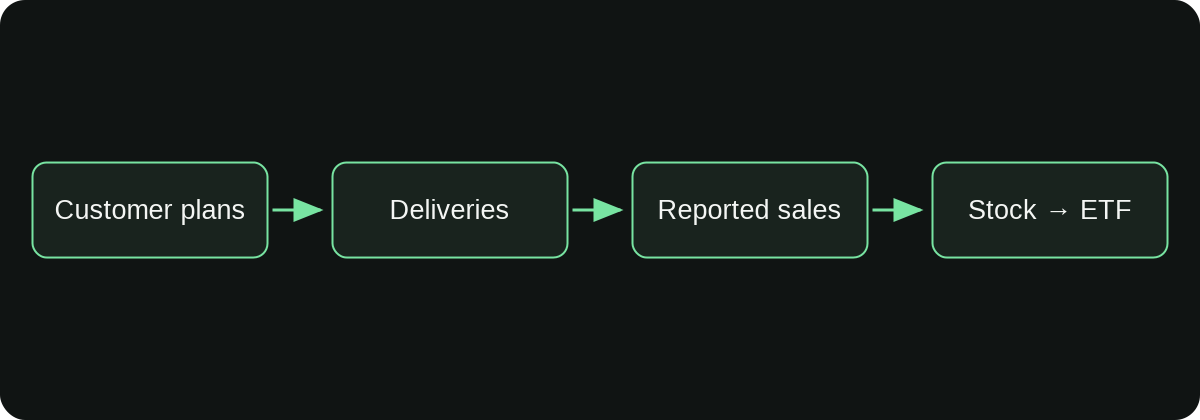
NVDL adds daily leverage to that stock-price link. It does not give its holders direct ownership of a data center or a fixed claim on GPU sales. To analyze the connection, follow the evidence from customer activity to financial results before discussing the leveraged instrument.
Start with the latest verified financial period
NVIDIA’s November 17, 2026 earnings release reports third-quarter fiscal 2027 revenue of $115.8 billion and Data Center revenue of $107.6 billion. The quarter ended October 25, 2026. Those dates matter: these are reported-period figures, not a live November sales counter.
The Data Center figure is approximately 92.9% of the reported total, calculated as 107.6 ÷ 115.8. This simple ratio shows the segment’s importance in that release. It does not establish the profitability of every product, identify all customers or forecast the next quarter.
Record the figures with their unit, period and official source. Do not combine a quarterly revenue number with an annual capital-spending headline and present the sum as NVIDIA demand. Different accounting periods and different companies’ budgets require a separate reconciliation.
Follow customer spending through the revenue chain
An announced data-center investment can include buildings, power, cooling, networking, processors, services and financing. Only part may become NVIDIA revenue, and that part can be recognized in a different period from the announcement.
A planned purchase is also different from a completed delivery. Customer commitments, product qualification, infrastructure readiness and acceptance conditions can affect when business activity reaches reported results. Without contract-level evidence, assigning an entire customer budget to NVIDIA would be speculation.
Use a chain of questions: who announced the spending, what category it covers, what period it spans, which suppliers are identified and what NVIDIA actually reports. An unanswered link should remain an uncertainty rather than becoming a precise revenue forecast.
Examine economics beyond the sales headline
Revenue growth is only one part of the business assessment. Product mix, pricing, costs, supply availability and service obligations can affect profitability. Review the issuer’s definitions and compare consistent measures when examining margins or earnings.
Cash generation and working-capital changes can provide additional context. A strong sales figure does not by itself explain the timing of customer payments, inventory commitments or future investment requirements. Those questions need financial statements and management disclosures, not a GPU-demand slogan.
Avoid assuming that a new chip announcement immediately replaces all existing products or that every announced deployment is incremental. Product transitions can create timing effects and execution demands. The relevant question is how the transition changes future business outcomes relative to what investors previously expected.
Separate good business news from a positive stock surprise
A stock reflects expectations as well as reported results. Strong growth can be followed by a decline if the market expected still stronger performance, while a modest improvement can be received favorably when prior expectations were low.
This guide does not supply a verified pre-release consensus dataset, so it does not label the November results a beat or calculate an earnings-surprise percentage. A defensible surprise measure needs a dated expectation, a matching accounting definition and a clearly identified reported outcome.
Valuation adds another layer. Investors can change the price they will pay for a given stream of expected earnings as yields, risk appetite or competitive assumptions move. The same revenue outlook can therefore coexist with different stock prices at different times.
Translate the stock move into the fund’s framework
The NVDL prospectus defines a leveraged daily exposure to NVIDIA stock. The connection is through the stock’s specified daily performance, not through a formula that doubles revenue growth or data-center capital expenditure.
If a demand announcement occurs during an extended session, align its public timestamp with the price window being studied. A move from an after-hours quote to the next morning is not automatically the fund’s close-to-close daily interval. The investor’s own fills introduce another measurement window.
Over several sessions, daily compounding changes the outcome further. Two companies reporting the same percentage sales growth would not imply equal stock returns, and the same final NVIDIA return can produce different leveraged paths. The compounding guide explains that second distinction.
Do not assign every move to AI demand
Company-specific and market-wide events can overlap with a demand headline. A leadership announcement, export-policy change or interest-rate repricing can enter the same window. If you cannot isolate the effect, describe the overlap rather than presenting a single-cause explanation.
For example, NVIDIA’s issuer-hosted November filing records the November 22 board decision and November 23 announcement reinstating Jensen Huang. That is a separate verified event from the November 17 earnings release. It should not be relabeled as new data-center sales or used to invent an NVDL reaction percentage.
The event-calendar workflow helps keep these timestamps and categories separate. A well-sourced narrative can explain plausible transmission channels without pretending that the exact contribution of each channel has been measured.
Maintain an evidence-based demand dashboard
A useful dashboard tracks official revenue periods, segment definitions, reported margins, management guidance and identified customer announcements. For each field, store the source date and whether it describes an actual result, a plan or an analyst estimate.
Update the dashboard when new primary evidence changes the case. Leave unverified order values or customer allocations blank. A missing field is more informative than a precise but invented number, particularly when the investment thesis depends on that assumption.
The final judgment should state what is supported and what remains uncertain. Demand can strengthen the business case while the leveraged fund remains unsuitable for a particular holding horizon or loss budget. Understanding the industry channel does not remove the product’s separate risks.
Frequently asked questions
Does Data Center revenue measure the whole AI market?
No. It is NVIDIA’s reported segment measure, not a census of every company’s AI spending. Definitions, products and recognition policies differ across suppliers, so aggregate-market claims need a broader and consistent dataset.
Can I infer NVIDIA sales directly from cloud GPU rental prices?
Rental prices reflect service terms, availability, utilization and the operator’s costs as well as hardware demand. They can provide context, but they do not directly reveal NVIDIA’s recognized revenue or margins without additional evidence.
Does NVDL receive a larger distribution when NVIDIA sells more chips?
There is no fixed pass-through formula from chip sales to an NVDL cash distribution. Consult the fund’s actual distribution notices and tax documents rather than treating operating growth as a promised payment to ETF holders.