 NVDL
NVDL’s objective applies to a defined trading day: twice NVDA’s percentage change before fund costs. It does not multiply the stock’s dollar price, guarantee an investor’s intraday return or fix a two-times relationship over several days. To understand a result, align the measurement period before applying any arithmetic.
Define the clock before calculating the return
The October 28, 2026 summary prospectus defines the relevant day from one regular-session close to the next. A trade entered after the market opens begins from a different price and exposure point. Your return must be calculated from your executed purchase and sale, not an earlier reference you did not trade.
This creates two separate calculations. One evaluates the fund’s stated daily objective using aligned observations. The other measures your investment using actual execution prices, quantities and cash flows. Both can be valid while producing different percentages, because they answer different questions.
Record four items before comparing: instrument, observation time, price convention and return treatment. The convention might be a market price or fund NAV, while the return treatment might include or exclude a distribution. A precise formula cannot repair incompatible inputs.
The one-day relationship is a target, not an invoice
For an idealized calculation, let r represent NVDA’s matched daily return in decimal form. The theoretical leveraged change is 2r. A starting fund value V would become V multiplied by (1 + 2r), before costs and any difference between the model and implementation.
For example, a hypothetical 5% underlying increase corresponds to a theoretical 10% fund increase under that simplified calculation. This is arithmetic, not a reported NVDL trading result or forecast. It assumes matched reference points and ignores implementation frictions that a real return contains.
The issuer’s objective description makes clear that the targeted multiple is not guaranteed. Use the calculation to test understanding and compare measurements; do not treat it as a limit order price, an execution promise or a way to predict the next move.
Over several days, multiply the daily factors
For underlying daily returns r₁, r₂ and so on, the underlying cumulative factor is the product of (1 + rᵢ). The simplified daily leveraged factor is the product of (1 + 2rᵢ). Subtract one from each product to obtain its cumulative return.
These products are generally different from applying two times to the final underlying return. Each daily factor operates on the previous day’s changed value. The difference emerges from the sequence and magnitude of moves, rather than from an automatic fixed penalty charged once at the end.
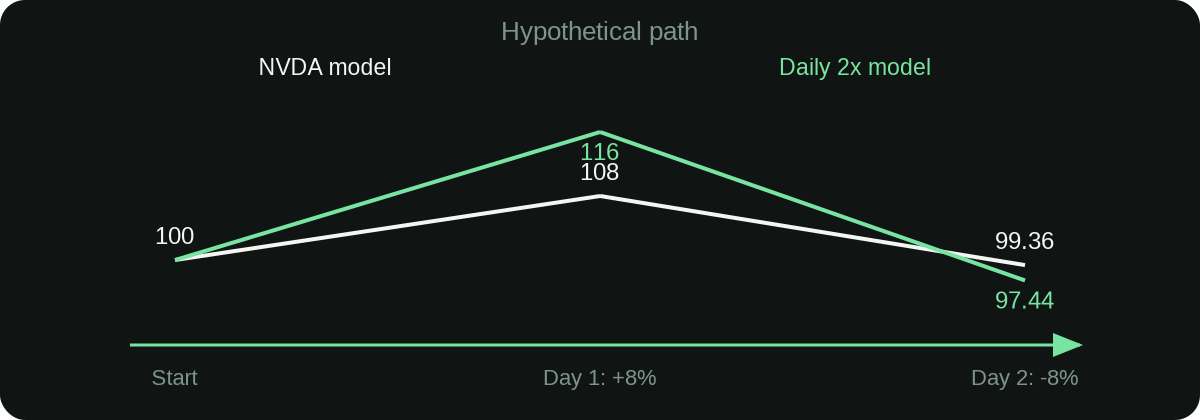
Consider two hypothetical underlying days: +8%, then −8%. An initial index of 100 becomes 108 and then 99.36. The simplified leveraged index becomes 116 and then 97.44. The stock path loses 0.64%; the leveraged path loses 2.56%, rather than the 1.28% obtained by simply doubling the total stock loss.
The included path calculator reproduces this multiplication. It uses an idealized model without real quotations, trading costs or predictions. Its purpose is to make assumptions inspectable, not to identify a profitable trading strategy.
A reversing path is not the same as a trend
Compounding can produce different relationships when moves persist in the same direction. Two hypothetical +8% underlying days produce a 16.64% cumulative increase; two +16% theoretical leveraged days produce 34.56%. That is greater than twice 16.64%, before the omitted real-world effects.
This does not make trending gains a reliable expectation. It demonstrates why “daily reset always causes a loss” is mathematically too broad. The same structure can amplify gains or losses, and the future return sequence remains unknown when a position is opened.
A useful comparison reports the path and assumptions explicitly. If someone shows only the beginning and ending NVDA price, ask for the intervening daily data before evaluating a daily leveraged model. Without that sequence, the simple model’s multi-day result cannot be reconstructed.
Why a personal intraday trade can differ again
The fund’s exposure relative to net assets can change during the session as prices move. Its daily objective is anchored to the specified period, rather than continuously promising every new buyer exactly twice NVDA’s return from that buyer’s purchase time.
Your order also encounters the ETF’s market bid and ask. A purchase near an ask and a later sale near a bid introduce execution effects absent from a NAV-only model. A short holding period does not remove those differences; transaction costs can matter more when the intended price move is small.
Use the NVDL quote guide to label these inputs. When comparing an actual trade with the target, do not attribute every deviation to the fund without checking the clock, spread, adjustment and reference-price choices first.
The formula has limits during extreme moves
The expression (1 + 2r) is a simplified mathematical factor, not a promise that an ETF account can have a negative share value. At sufficiently extreme losses, the model no longer describes a normal continuing positive-value investment. Fund terms, market conditions and operational responses must be examined instead.
Likewise, the model does not determine an opening quote after a gap or the price of a partial fill. Those are market observations. An educational calculation should remain labeled as such even when its arithmetic is exact.
To reconcile a real holding, retain confirmations, cash flows and matching return series. Separate the modeled effect of daily compounding from expenses and execution. That decomposition is more informative than a single accusation that the ETF failed to move “double.”
Frequently asked questions
Can I double an expected NVIDIA earnings move to set a guaranteed target?
No. An expected move is an estimate, and the announcement may be incorporated across sessions. A scenario can illustrate sensitivity but cannot guarantee the underlying move, the fund return or the available execution price.
Does buying twice as many NVDL shares change the fund’s target?
No. It changes the size of your position, not the investment objective. The dollar risk grows with the quantity held, while each share remains subject to the same fund mechanics and market conditions.
Should percentages be added when reconstructing a multi-day return?
Not for an exact compounded result. Multiply the daily factors on a consistent basis. Adding percentages can provide only a rough approximation in limited circumstances and can become misleading as moves grow.