 NVDL
NVDL is the GraniteShares 2x Long NVDA Daily ETF, a fund targeting twice NVIDIA stock’s daily percentage change before fees and expenses. It is a leveraged trading product, not NVIDIA common stock and not a promise to double a long-term investment. Understanding the word daily is essential before considering a purchase.
Start with the investment you would actually own
Buying NVDL through a brokerage account gives you shares of the ETF. Its exposure is linked to NVIDIA, whose common stock trades as NVDA. The similar tickers make identification important: an order for one does not purchase the other, and an additional suffix on an unrelated platform may identify a different contract entirely.
The issuer’s fund page identifies the product and its objective. Use the complete legal name when checking a broker’s search result, then confirm the ticker, exchange information and product type. A search suggestion containing NVIDIA is not enough to distinguish shares, options, funds and other instruments.
Write down the instrument in plain language before opening an order: shares of a daily leveraged ETF linked to one company. That description makes two important features visible. The position is concentrated in NVIDIA-related risk, and the leverage is designed around a defined daily measurement period.
What the daily target does—and does not—mean
The target describes a percentage return over the fund’s measurement period, rather than a fixed dollar change. It does not mean NVDL should trade at twice NVDA’s share price. Their prices reflect different shares, histories and adjustments, so comparing the dollar levels alone tells you little about the intended exposure.
The SEC’s introduction to single-stock ETFs explains why these products differ from diversified funds. A bullish view on artificial intelligence does not diversify a position tied to one stock. NVIDIA-specific developments can affect the entire underlying exposure rather than a small portion of a broad portfolio.
Your personal holding period also matters. A purchase halfway through a session starts from the ETF price you actually pay. A sale several days later includes a sequence of changing daily returns. Neither situation automatically corresponds to the fund’s advertised multiple applied to your chosen start and end points.
How to read the fund without confusing assets and exposure
A leveraged fund can use derivatives to obtain exposure exceeding its net assets. Its cash or collateral holdings therefore do not tell the whole economic story. When examining documents, separate the property held, the contractual exposure and the liabilities or financing arrangements that connect them.
The current summary prospectus is the appropriate starting point for the strategy and permitted instruments. Do not assume a short marketing sentence describes every instrument the fund may use under different conditions. Equally, a list of permitted strategies is not proof that each appears in today’s portfolio.
A practical reading method uses three questions: what return is sought, how can that exposure be obtained, and what can prevent the objective from being met? Record the document date alongside the answers. A holdings download, a factsheet and a financial statement answer different questions and may cover different dates.
Why the holding period changes the result
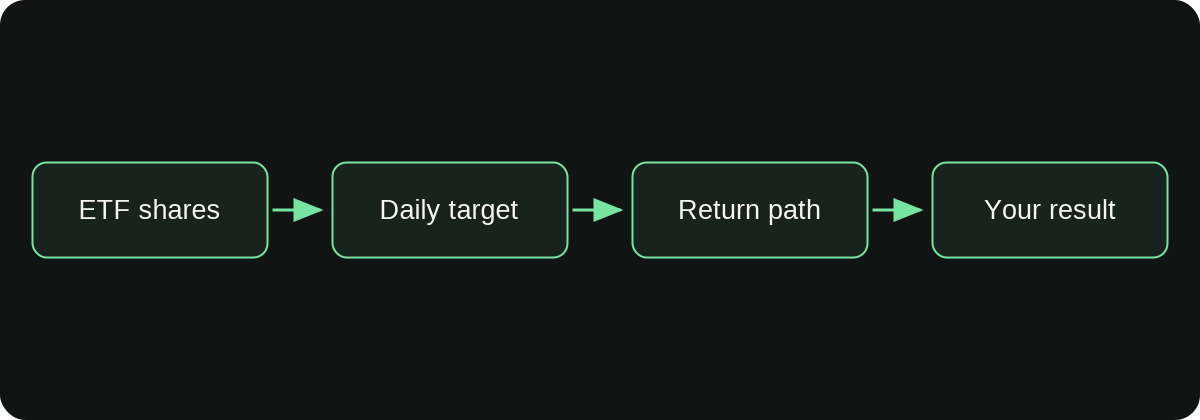
Daily returns compound. After a gain or loss, the next percentage return applies to a changed investment value. A sequence of leveraged daily returns can therefore differ from twice the underlying stock’s total return over the same sequence. Direction alone does not determine the outcome; the path matters too.
That does not mean the ETF must lose value every time it is held for several days. Persistent moves and alternating moves can produce different arithmetic. The useful conclusion is narrower: you cannot infer the fund’s multi-day return simply by doubling NVDA’s start-to-finish percentage change.
The guide to NVDL’s daily leverage calculation provides a reproducible method. It distinguishes an idealized calculation from a real trade, whose outcome also depends on costs, tracking, market prices and execution. An illustrative calculation should never be presented as an observed return or a forecast.
The price you see is not necessarily the price you receive
ETF shares trade at market prices. A last trade, a bid, an ask and a published net asset value are different observations. A quote can also be delayed or belong to a different trading session. Before relying on a number, check its field, timestamp and source.
An order needs instructions about quantity, price and duration. Those instructions involve trade-offs: a price constraint can prevent execution, while an unrestricted market order can execute at a less favorable price than expected. An order accepted by a broker is not proof of a completed purchase.
For the quote-reading task, use the NVDL price and chart guide. A static educational article cannot act as a live price feed. An unavailable number should remain unavailable rather than be filled with an old quotation labeled as current.
A learning sequence before the first order
Begin by comparing NVDL with ordinary NVIDIA shares. Then explain the daily calculation in your own words and identify the period over which your proposed trade would run. If the intended holding period and the daily target do not match, describe the consequence rather than dismissing it as a technical detail.
Next, identify the money at risk, the information you will monitor and the conditions that would change your decision. Include the possibility of an opening gap and an unfilled exit. A plan relying on perfect execution or a guaranteed rebound is incomplete, regardless of how convincing the company’s long-term story appears.
Finally, check the broker’s actual product access and disclosures. Availability is not an endorsement of suitability. You can finish this learning process and decide not to trade; understanding a product does not create an obligation to own it.
Frequently asked questions
Is NVDL itself an AI company?
No. It is an exchange-traded fund linked to the performance of NVIDIA stock. References to AI demand describe a possible influence on NVIDIA’s business and valuation, not an operating business conducted by the ETF itself.
Does a lower NVDL share price make the exposure cheaper than NVDA?
Not by itself. Share prices depend on the number of units and corporate actions. Compare dollar exposure, costs and risk rather than treating the lower-priced share as a bargain because its number is smaller.
Can an investor outside the United States automatically buy it?
No. Access depends on residence, local rules, broker policy and account permissions. A publicly accessible quote page does not establish that the product can be offered to a particular person or account.