 NVDL
Daily rebalancing adjusts NVDL’s intended exposure relative to its changing net assets. It does not reset your account balance, erase a loss or promise the same exposure from every intraday entry point. The process helps implement a daily objective while making longer holding-period results sensitive to the sequence of returns.
Separate a changing value from a changing target
A leverage ratio compares exposure with the capital supporting that exposure. When the underlying price changes, both the value of the fund and the exposure represented by its instruments can change. They do not necessarily change in proportions that preserve the desired ratio without adjustment.
The fund’s strategy disclosure describes an approximately 200% end-of-day notional exposure objective. This is a portfolio-level concept. The manager may implement it through financial instruments; it should not be interpreted as a rule requiring a particular stock-market order of a predetermined size.
Your own brokerage position is a separate layer. If you hold a fixed number of ETF shares, their value changes with the share price. The fund’s internal process does not automatically sell part of your account, restore your original dollars or maintain a constant dollar allocation within your broader portfolio.
A simple exposure ledger shows why an adjustment can be needed
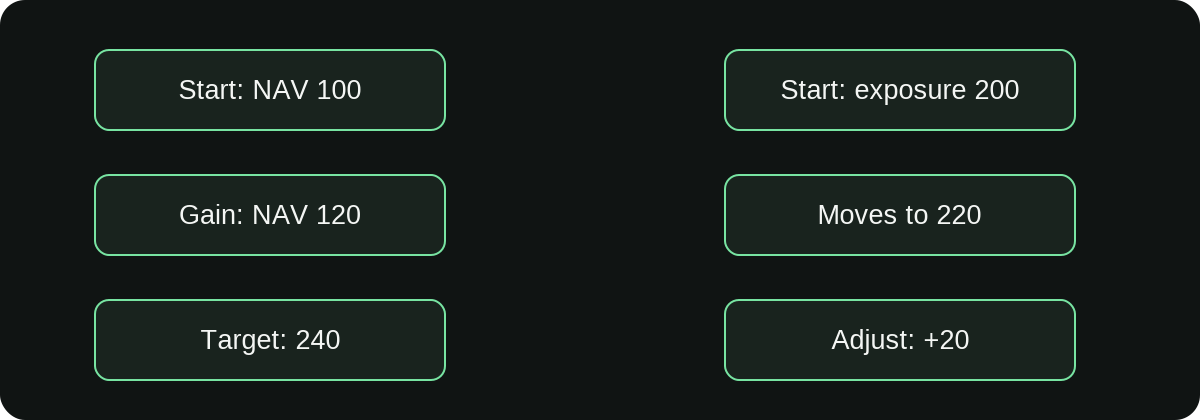
Take a hypothetical fund with 100 units of net assets and 200 units of underlying exposure. Ignore financing and other complications to isolate the relationship. If the underlying rises 10%, a simplified leveraged result adds 20 to net assets, bringing them to 120.
If the earlier exposure moves from 200 to 220 in this model, it is now about 1.83 times the new net assets. An exposure target of twice 120 corresponds to 240, requiring an increase of 20 in modeled notional exposure. These units are explanatory amounts, not disclosed NVDL trades.
Now examine a separate hypothetical day starting again from 100 and 200. A 10% underlying decline would reduce modeled net assets to 80 and the earlier exposure to 180. Twice 80 is 160, implying a reduction of 20 in modeled exposure. The starting point is reset for this illustration, not carried over from the gain example.
Do not turn the ledger into a prediction of closing order flow
Actual implementation can involve swaps, other permitted instruments, subscriptions and redemptions, financing and changing market conditions. The simple ledger does not reveal the manager’s exact transactions, counterparties or timing. It cannot establish how much NVDA stock will be bought or sold into a particular close.
It is therefore inappropriate to look at a candle and infer the fund’s rebalance quantity from it alone. A chart does not contain the fund’s complete current asset, derivative and flow information. A calculation based on assumed assets remains an assumption until supported by relevant records.
The useful information gain is a way to audit the relationship: exposure, net assets and intended ratio. If a commentary makes a concrete flow claim, ask for those inputs, their timestamps and the implementation assumptions. A directionally plausible story is not a measured order imbalance.
Rebalancing and compounding describe related, different things
Rebalancing concerns the portfolio adjustments used to pursue the objective. Compounding concerns how successive percentage returns act on changing value. One describes an implementation process; the other describes arithmetic over time. They should not be collapsed into a vague fee called decay.
The SEC bulletin on leveraged and inverse ETFs explains why daily resetting matters for longer holdings. It does not supply a universal daily loss rate that can be subtracted from every NVDL position. The return path, costs and actual tracking must be examined separately.
For calculations, the daily-leverage guide shows the multiplication of return factors. Use it to distinguish a path effect from a tracking difference. Otherwise, a result that follows the modeled daily arithmetic may be incorrectly described as a failure to rebalance.
What this means for buying before or after the close
A trade near a measurement boundary still has an actual price and time. Buying before the close does not guarantee access to NAV or to the exact start of the next target interval. Execution, quote changes and the broker’s order handling determine the shares you receive and their cost.
A trade later in the session begins after part of the underlying move may already have occurred. The fund’s current exposure relative to value may differ from the target applied at a boundary. Avoid assuming that an equal remaining stock move creates the same personal percentage return at every entry time.
This observation is not a recommendation to trade at a particular minute. Timing choices involve spreads, available liquidity, news and order rules. An explanation of rebalancing cannot identify a universally best entry point or eliminate an opening gap.
Monitor the fund and the personal position at their own levels
For the fund, follow objective changes, published holdings dates and relevant notices. For the personal position, track quantity, execution prices, cash flows and the expected holding horizon. Confusing these records makes it harder to diagnose a return difference.
If a corporate action changes the number of shares, distinguish that event from the exposure adjustment. A share split changes units without, by itself, replenishing lost wealth. Rebalancing changes the fund’s implementation rather than simply renaming each share.
Keep a short reconciliation note whenever you review the holding: the fund’s reporting date, your trade interval, the price convention and the question being tested. This discipline prevents a daily mechanical explanation from becoming an unsupported claim about your account.
Frequently asked questions
Does the fund rebalance my other investments?
No. Its portfolio process operates inside the ETF. The allocation among positions in your own account remains a separate decision or a separate advisory service, if one has been arranged.
Does a daily reset guarantee a fresh start after a large loss?
It does not restore the lost capital. Subsequent percentage changes apply to the remaining value, subject to actual fund operations. Recovering an earlier dollar level can require a larger percentage gain than the percentage previously lost.
Can I observe the exact rebalance from public trade volume alone?
No. Volume does not identify every participant, derivative adjustment or fund flow. A concrete estimate requires appropriately timed exposure and asset information plus implementation assumptions; it should not be presented as a directly observed fact.