 NVDL
You may be able to keep NVDL shares for an extended period, but the fund is not designed to deliver twice NVIDIA’s long-term return. A longer holding requires accepting daily compounding, concentrated downside and ongoing monitoring rather than treating the ETF as a passive stock replacement.
This does not mean every long holding must lose money. A persistent favorable trend can produce strong compounded gains. It means the result depends on the path, costs and entry conditions, so a bullish multi-year opinion about NVIDIA does not by itself justify choosing daily leverage.
Distinguish permission from investment fit
A broker allowing the position to remain open does not establish that the fund suits a retirement plan, emergency reserve or long-term accumulation strategy. Permission answers an account-access question. Suitability depends on the intended task, loss capacity and ability to manage the exposure.
The NVDL summary prospectus emphasizes informed, active monitoring and a daily objective. Read that together with the SEC leveraged-ETF bulletin, which explains why a longer-period result can diverge from a simple multiple of the underlying’s return.
Write the intended role in plain language. “Participate in NVIDIA’s business over several years” and “take a short amplified view before a specific review point” are different jobs. A product designed around the second should not be selected for the first merely because its recent gains look attractive.
Compare a trend with a reversal
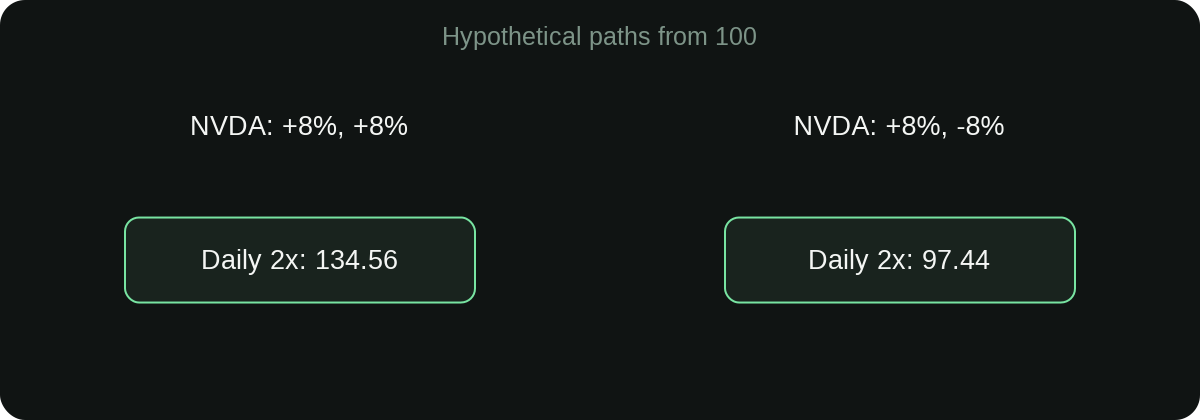
In an idealized model, two NVIDIA gains of 8% produce a stock index of 116.64 from 100. A daily-2x model reaches 134.56, exceeding the 133.28 implied by simply doubling the stock’s cumulative gain. Compounding is not always an additional loss.
Change the second day to −8%, and the same stock index finishes at 99.36 while the leveraged model finishes at 97.44. Both illustrations exclude expenses and tracking effects. They demonstrate sensitivity to the sequence rather than the probability of either outcome.
| Hypothetical two-day path | Stock model | Daily-2x model |
|---|---|---|
| +8%, +8% | 116.64 | 134.56 |
| +8%, −8% | 99.36 | 97.44 |
Extending the holding period introduces more daily factors. The terminal NVIDIA price alone is insufficient to reconstruct the leveraged result. The path calculator lets you inspect this mechanism without claiming to forecast which sequence the market will produce.
Understand how drawdowns change the recovery task
After a percentage loss, the gain needed to recover is larger than the loss percentage. A holding that falls 40% must gain 66.67% from the reduced value to return to its starting point, before costs. This arithmetic applies to investments generally; daily leverage can make the underlying decline translate into a much larger fund drawdown.
Do not infer that a stock returning to its old high necessarily restores the ETF’s old value. The intervening leveraged path, fund costs, distributions and any share adjustments need to be included. A chart based only on raw share prices may answer the wrong recovery question.
Adding new money can lift the account balance without repairing the return on the original shares. Evaluate contributions separately from investment performance. Otherwise, a strategy can appear to recover simply because the investor supplied more capital after losses.
Include costs without inventing a constant decay rate
Longer holding periods expose the investment to operating and financing effects as well as compounding. Use the current fee disclosure rather than assuming the headline management charge is the complete cost. Waivers and excluded expenses require their own reading.
However, it is also wrong to subtract a fixed “volatility decay fee” from every day. The compounding effect depends on the path and can be favorable in a trend. The mathematical explanation isolates that mechanism from the separate expense discussion.
Any historical comparison should use consistent total-return conventions, corporate-action adjustments and dates when the objectives were comparable. NVDL previously used a different leverage target before its January 2024 change, as noted in the issuer factsheet. Treating the entire inception history as a constant-2x experiment would be inaccurate.
Assess whether the monitoring commitment is realistic
A long holding can span earnings, product transitions, policy changes and market closures. Review not only whether you are willing to monitor, but whether you can respond when the relevant event occurs. An alert during an unavailable session may not permit an immediate exit.
Set review points based on the investment role and risk conditions. Reassess overlapping NVIDIA exposure elsewhere in the account, funding needs and open orders. A portfolio that was manageable when the position was small can become concentrated after gains or additional purchases.
A rule that says “never sell until breakeven” provides no forward-looking risk assessment. The acquisition price is relevant to records and taxes, but it does not determine whether the next interval’s exposure is appropriate. Compare retaining the position with the alternatives available now.
Compare alternatives without assuming they are risk-free
Direct NVDA shares remove the daily leveraged-fund objective while retaining company concentration and valuation risk. A diversified fund can reduce reliance on a single issuer but introduces a different exposure. Holding cash changes both market participation and purchasing-power risks.
Options, margin borrowing and other leveraged ETFs require their own analysis; they are not automatic solutions to a long-horizon mismatch. Compare the full structure, including expiration, financing or reset mechanics, rather than looking only for a different way to obtain the same headline multiplier.
The conclusion should follow from the job and constraints, not from a universal maximum number of holding days. There is no duration that guarantees safety, and no calendar threshold that suddenly turns an unsuitable plan into a suitable one.
Frequently asked questions
Can I judge suitability from an annualized return figure alone?
No. That figure compresses a path and can conceal drawdowns, monitoring demands and objective changes. Review the underlying series and the account’s ability to withstand losses rather than relying on one endpoint statistic.
Does a long investment horizon guarantee time to recover?
It provides more elapsed time, not a guaranteed favorable outcome. The company, market and fund can evolve, and losses can permanently reduce the capital available for later compounding. Future returns need not repeat a historical recovery.
Could the fund close before my planned investment horizon ends?
An ETF is not guaranteed to remain open indefinitely. If a closure or liquidation is announced, read the issuer’s notice for trading deadlines, cash treatment and account consequences. Do not assume your intended holding date overrides the fund’s legal timetable.