 NVDL
For a US individual holding NVDL in a taxable brokerage account, a sale generally creates a capital gain or loss, while fund distributions can create separate taxable items. The ETF’s daily 2x objective does not give its shareholder a special universal tax rate.
Begin with the account type and actual records. This guide addresses general federal treatment for investors, not trader-status elections, nonresident taxation or an individualized filing conclusion. State rules and personal circumstances can change the final liability even when two people traded the same ticker.
Keep the share sale separate from the fund’s transactions
Your purchase and sale of ETF shares are not the same transactions as the swaps or other instruments inside the fund. Do not copy a tax rule for a derivative contract onto your ETF-share sale merely because NVDL uses derivatives.
The fund’s tax disclosure distinguishes taxable distributions from gains or losses on selling shares. The IRS capital-gains overview explains the general sale framework. A filing starts with proceeds and adjusted basis, rather than with the leverage multiplier or the company’s change in stock price.
For a hypothetical lot costing $2,000 and sold for $2,300, the initial difference is $300 before relevant adjustments. That is an illustration, not a completed NVDL trade. Reconcile fees, basis changes and any loss-deferral rules before using the final figure on a return.
Classify the holding period and distribution correctly
A sale held for one year or less is generally short term; longer holdings generally receive long-term capital treatment. The applicable tax rate depends on the taxpayer and category of income. There is no single rate that can accurately describe every US NVDL investor.
Fund distributions require a separate classification. Ordinary dividends, qualified dividends, capital-gain distributions and nondividend distributions are not interchangeable. A marketing page’s “yield” label does not establish which category applies to a particular payment.
Use the broker’s tax reporting and any corrected forms, checking discrepancies against fund notices. Reinvesting a taxable distribution does not automatically remove its taxable character; it also creates acquisition records that need to be maintained. The absence of cash withdrawn from the brokerage account is not a general exemption.
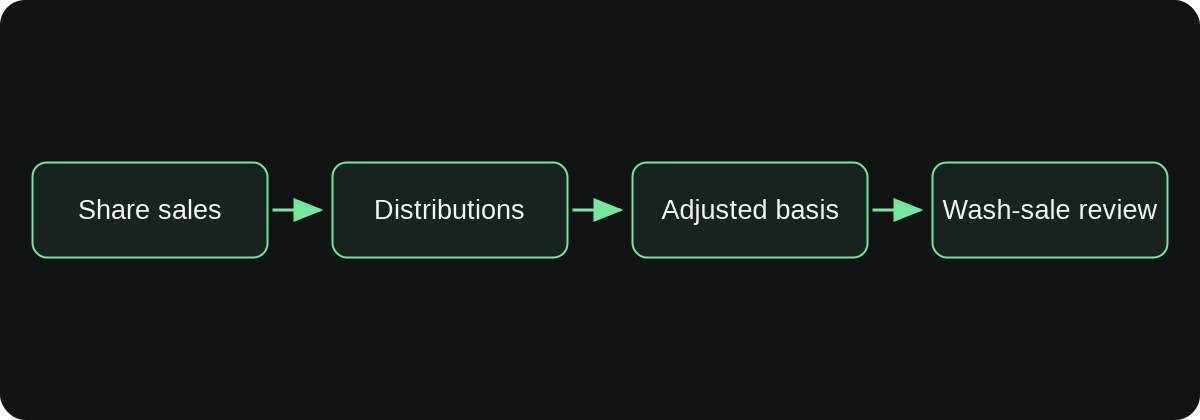
Review wash sales across the relevant accounts
IRS Publication 550 describes loss-sale restrictions involving substantially identical securities acquired within 30 days before or after the sale. A repeated NVDL purchase can therefore complicate a plan to realize a deductible loss.
Review automatic reinvestments, recurring purchases, spouse transactions and other accounts rather than relying only on one platform’s visible trade list. The broker’s reported wash-sale adjustment may not identify every transaction relevant to your return. Accurate dates and lot quantities matter when only part of a position is replaced.
Do not assume that switching from NVDL to another NVIDIA-linked product creates an automatic safe harbor. Whether securities are substantially identical depends on the facts; similar exposure alone does not settle every legal question, and a different ticker alone is not a complete analysis.
An IRA or Roth IRA replacement can also have consequences that differ from an ordinary taxable-account replacement. Seek qualified tax help before executing a loss-harvesting sequence across account types rather than treating the retirement wrapper as invisible to the wash-sale review.
Build the record before the filing deadline
Maintain a lot-level ledger containing acquisition dates, quantities, purchase amounts, sales, adjusted basis and distributions. Preserve confirmations, statements, corporate-action notices and tax forms. A profit figure on a trading dashboard can use a different convention from the amount reportable for tax.
Check split adjustments. NVDL’s share history includes corporate actions, and a change in quantity should not be mistaken for a new cash investment. A broker transfer can also leave missing basis information that must be reconstructed from original records.
| Record | Why it matters |
|---|---|
| Trade confirmations | Establish quantities, dates and executed amounts |
| Distribution detail | Separates payment character from a displayed yield |
| Basis adjustments | Prevents comparing proceeds with an outdated cost |
| Cross-account purchases | Helps identify potential loss-deferral issues |
| Corrected tax documents | May supersede an earlier statement used in a draft return |
For ordinary securities reporting, Form 1099-B, Form 1099-DIV, Form 8949 and Schedule D may be relevant depending on the transaction and reporting exception. Use the instructions for the tax year being filed. A prior-year publication explains general concepts but does not establish every current-year threshold or line instruction.
Do not let the tax wrapper decide the investment
A tax-advantaged account changes the reporting framework; it does not eliminate the economic consequences of daily leverage. A traditional IRA and a Roth IRA also have different distribution rules. Consult the applicable account guidance rather than treating both as simply “tax-free.”
The retirement discussion addresses the investment role separately. Avoid retaining an otherwise unsuitable leveraged position solely to reach a tax holding-period milestone. A possible tax benefit is not a guarantee that the additional market risk is justified.
Likewise, a realized investment loss does not mean the government reimburses the full loss. Offsetting rules, limits and carryovers can affect when and how a loss is usable. Calculate the portfolio result before describing a tax consequence as a recovery of the money lost.
Resolve exceptions before submitting the return
Ask a tax professional about unresolved basis, cross-account replacement purchases, special elections or complex offsetting positions. Supply the complete ledger rather than only the winning and losing trades you remember. The quality of the conclusion depends on the facts provided.
No tax rate or filing outcome is promised here. The practical goal is a reconciled record that distinguishes share-sale results, distributions and account rules. That record remains useful even if the eventual return requires treatment beyond the general investor framework described above.
Frequently asked questions
Does frequent trading automatically make me a trader for tax purposes?
No. The IRS applies factual criteria, and special elections have their own requirements and timing. A high number of app orders does not by itself establish eligibility for a different tax regime.
Is transferring shares between my own brokers the same as selling them?
An in-kind transfer is generally different from a sale, but fractional liquidation or other transactions during the transfer can create reportable events. Check the confirmations and basis record instead of treating the entire transfer as one undifferentiated movement.
What should I do if a corrected form arrives after I file?
Compare the correction with the submitted return and obtain advice on whether an amendment or other response is required. Preserve both versions and the reconciliation; do not assume a small correction is automatically irrelevant.