 NVDL
A sharp NVIDIA decline can produce an amplified NVDL loss over the fund’s daily measurement period. A simplified −20% NVDA day corresponds to a −40% daily-2x model before costs, but that model is not a guaranteed exit price or a rule that remains valid through every extreme event.
The useful calculation has three parts: the immediate decline, the remaining capital and the gain needed to recover. Keep the investor’s actual entry and executable market prices separate from the fund’s close-to-close objective when applying those steps to a real holding.
Work through a single adverse day
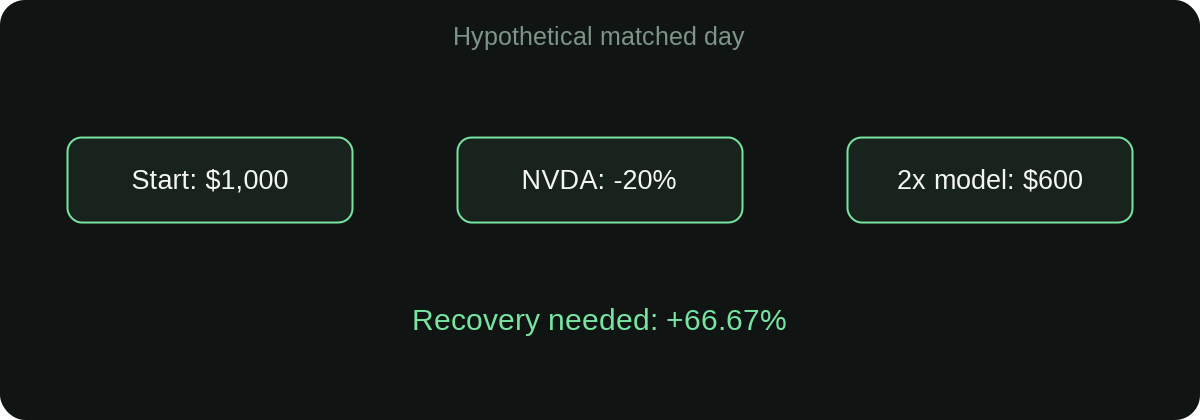
Assume an entirely hypothetical starting investment of $1,000 and a matched NVIDIA daily return of −20%. Applying a daily +2x factor gives $1,000 × (1 − 0.40) = $600. The modeled dollar loss is $400.
This example omits operating expenses, financing, tracking differences, distributions and trading friction. It does not claim that NVIDIA declined by this amount on a particular date. Its purpose is to expose the dollar consequence of an assumed move before a trader mistakes the ETF’s low unit price for limited economic risk.
| Assumed matched NVDA day | Idealized daily-2x change | Remaining value from $1,000 |
|---|---|---|
| −5% | −10% | $900 |
| −10% | −20% | $800 |
| −20% | −40% | $600 |
| −30% | −60% | $400 |
NVDL’s summary prospectus warns about leverage and the possibility of losing the full investment. The table illustrates moderate-to-severe scenarios within a simple model; it is not a probability distribution or a maximum-loss estimate for a financed account.
Calculate recovery from the reduced balance
Recovering a loss requires a gain on the remaining capital. In the $600 example, reaching the original $1,000 requires $400 ÷ $600, or approximately 66.67%. A subsequent 40% gain would bring the position only to $840.
The underlying stock has its own recovery arithmetic. After a 20% drop, it needs a 25% gain to return to its original level. An idealized daily-2x investment experiencing −40% and then +50% ends at $900 from $1,000, despite the underlying completing that two-day round trip.
That sequence is also hypothetical. It demonstrates why “NVIDIA recovered, so my leveraged ETF must recover” is an unreliable statement. Actual recovery additionally depends on the number and size of intervening daily moves, implementation and the investor’s entry prices.
Identify when the simple multiplier breaks down
The formula 1 + 2r reaches zero when the assumed underlying daily return is −50%. Below that point it becomes negative, which is not a meaningful positive-share-value continuation of this elementary model. Do not extend a spreadsheet line through that boundary and publish its output as an actual ETF payoff.
An extreme market event can involve derivative constraints, trading interruptions, rebalancing difficulty and other provisions in the fund documents. The exact treatment requires the relevant current documents and facts. The possibility of full principal loss is enough to invalidate a plan that assumes the fund must retain a recoverable residual value.
A fully paid cash purchase of ETF shares is also different from financing the purchase with broker credit or selling shares short. Account obligations can create additional losses and restrictions. Review the entire transaction rather than interpreting the model’s starting principal as a universal boundary on every related strategy.
Separate a daily decline from an overnight gap
An investor buying midday and selling at the next open holds a different interval from the fund’s stated daily target. Even when the day’s NVIDIA headline return is accurate, simply doubling it may not explain that investor’s share-price result.
A gap can also bypass a planned stop level. The SEC stop-order bulletin explains that execution can differ from the trigger and that a stop-limit can remain unfilled. A large loss calculation therefore needs an adverse executable-price scenario, not only the preferred stop price.
Confirm the session in which an order can trigger and whether NVDL is eligible for that session at the broker. A market closed for a holiday does not provide continuous access just because the account displays a last price. The overnight review addresses that operational gap.
Respond to the actual position rather than the original plan
After a sharp move, reconcile filled trades, available shares and pending exits. A partial sale leaves a remaining position; a cancellation request does not prove an existing order has stopped working. Inspect the account before submitting another potentially conflicting instruction.
Then reassess the reason for holding the residual exposure. Adding shares lowers an average cost only by committing more capital; it does not make the next daily path more favorable. A decision to add should stand on its own evidence and risk budget.
If the original plan depended on losses staying below a small fixed amount, the gap has revealed a weakness in that assumption. Document the failure rather than rewriting the original stop as though it had guaranteed protection. The mistake-review guide helps distinguish market loss from process failure.
Use stress tests before the next trade
Compare several loss sizes with the account’s cash needs and overlapping NVIDIA exposure. Avoid presenting the largest tested decline as the worst possible outcome. Stress tests expose sensitivity to assumptions; they do not establish the probability or outer boundary of future events.
A position small enough to monitor and absorb can still have an unsuitable objective. The SEC’s single-stock ETF overview explains why concentration remains important. Diversification, leverage, execution and funding are separate questions, and solving one does not automatically solve the rest.
Frequently asked questions
Does a trading halt stop the economic risk from changing?
No. Information and valuation expectations can change while execution is unavailable. When trading resumes, the available price may differ substantially from the last pre-halt print. Check the broker’s handling of outstanding orders during the interruption.
Can a reverse split restore the money lost in a decline?
A reverse split changes share count and per-share price according to its terms. It does not by itself rebuild the position’s total economic value. Compare adjusted quantities and total value instead of interpreting a higher unit price as recovery.
Will a margin call arrive before the ETF becomes dangerous?
Do not rely on that. A cash position can lose substantially without a margin call, while a financed account follows separate broker requirements that can change. A notification is not a substitute for a pre-trade loss assessment.