 NVDL
NVDL is a poor match for an unattended retirement core that must support diversified, scheduled spending. Its daily leveraged NVIDIA exposure can create large drawdowns and monitoring demands that an IRA or other retirement wrapper does not remove.
This is a product-role assessment, not a claim that every retiree has identical finances or that every brokerage forbids the ETF. The important distinction is between permission to hold a security and whether its risk structure fits the household’s income, time horizon and ability to replace lost capital.
Begin with the spending obligation
List essential expenses, reliable income sources and the amount that must come from investments. Then identify when withdrawals are needed. Money required for near-term living costs has a different job from capital that can tolerate a severe loss without disrupting those expenses.
The Department of Labor’s Savings Fitness guide discusses investment risk in the context of retirement planning. Use the household’s actual needs rather than assuming that a long remaining lifespan makes every volatile investment appropriate.
NVDL’s fund disclosure describes a daily trading objective and active monitoring expectations. That design should be tested against the spending schedule before considering an attractive historical return. A product can offer the desired direction while being poorly matched to the required reliability of the funds.
Distinguish two different path problems
Daily leverage creates path dependence inside the investment. Retirement withdrawals create an additional sequence issue: taking money out after losses leaves less capital available for a later rebound. These mechanisms can interact, but they should not be conflated.
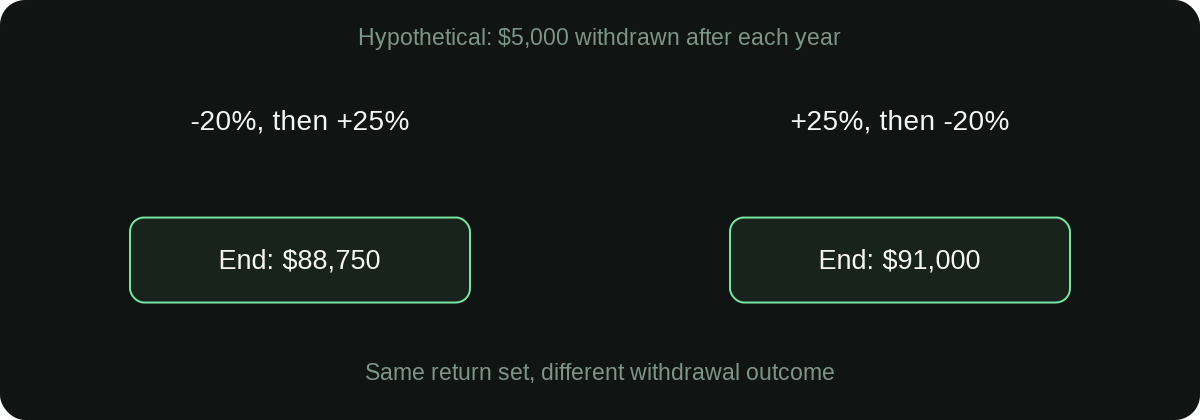
Consider a hypothetical portfolio starting at $100,000, with $5,000 withdrawn after each of two annual returns. A −20% year followed by +25% leaves $88,750 after both withdrawals. Reversing those returns leaves $91,000, even though the investment factors before withdrawals multiply to the same amount.
| Illustrative order | After year-one return and withdrawal | After year-two return and withdrawal |
|---|---|---|
| −20%, then +25% | $75,000 | $88,750 |
| +25%, then −20% | $120,000 | $91,000 |
This is a general withdrawal illustration, not a simulated NVDL strategy or a suggested spending rate. It isolates why forced sales and return timing matter. Daily leveraged-fund mechanics would require a separate daily-path calculation rather than annual returns multiplied by two.
Check concentration across the entire household
A retirement account may already hold NVIDIA through direct stock, semiconductor funds or broad equity funds. Employment income, deferred compensation or a spouse’s portfolio can add related exposure. Several account names do not necessarily represent independent risk sources.
Use actual holdings to identify overlap. NVDL adds concentrated daily leverage to one company; its ETF status does not make it a diversified retirement allocation. The SEC asset-allocation guide explains why horizon and risk tolerance belong in allocation decisions.
Do not choose a universal “safe percentage” from an article. A modest allocation for one household can be consequential for another with less income flexibility or fewer replacement resources. The analysis needs the overall plan rather than the ETF position alone.
Separate account taxation from investment safety
A traditional IRA, Roth IRA and employer plan have different contribution, distribution and eligibility rules. Tax treatment does not change what happens economically when a leveraged position loses value. A tax-advantaged wrapper does not reimburse principal.
For accounts subject to required distributions, follow the applicable rules even if a holding has declined. IRS Publication 590-B explains IRA distribution requirements and points to updates. The rules are account- and person-specific; this guide does not assign a universal starting age, amount or deadline.
Some brokers or plans restrict complex products. Verify the actual account’s permission and procedures rather than treating access in a taxable account as proof of retirement-account access. Any decision to transfer or roll over assets also requires analysis beyond obtaining a particular ticker.
Evaluate whether monitoring is realistic
A leveraged position may require attention during earnings, corporate announcements and market interruptions. Retirement does not automatically create the time, health or interest needed to manage that exposure. A plan should also work when the primary account holder cannot monitor it.
Identify who can act, what instructions exist and how the household accesses records. Avoid a strategy dependent on one person responding instantly to an alert. Broker rules, trading sessions and price gaps can prevent the intended response even when the notification arrives.
If a small tactical allocation is being considered outside essential spending assets, it still needs a defined purpose, loss boundary and review process. Calling it a satellite position does not itself make the risk appropriate or eliminate the possibility of a large loss within that allocation.
Compare tools by their retirement role
A diversified equity fund may address long-term growth more directly, while other holdings can address liquidity or income under their own risks. Direct NVIDIA shares retain company risk but do not contain the ETF’s daily-2x objective. None should be labeled universally safe.
NVDL also lacks a guaranteed distribution stream for matching household spending. Check the distribution analysis before relying on a yield field. Selling shares can generate cash, but it reduces capital and can force realization after unfavorable returns.
The decision should document how the investment serves the plan, how losses affect spending and what happens if monitoring fails. If those answers are unresolved, brokerage availability or enthusiasm about AI growth is not enough to fill the gap.
Frequently asked questions
Can I replace lost IRA capital with unlimited new contributions?
No. Contributions are governed by eligibility and annual limits, among other rules. An investment loss does not create unrestricted contribution room. Review the applicable IRS rules before assuming outside savings can simply refill the account.
Does a younger spouse’s longer horizon remove the withdrawal problem?
No. Household needs and account rules still determine when money is required. A longer horizon can be relevant, but it does not erase near-term expenses, concentration or the consequences of drawing on a reduced balance.
Should an adviser review the product or the entire retirement plan?
The whole plan matters: income, withdrawals, other assets, taxes and decision-making capacity can change the assessment. Ask how the proposed position serves those needs and how the adviser is compensated, rather than requesting only a ticker-level opinion.