 NVDL
NVDL can make distributions, but it does not promise a regular income stream or pass through twice NVIDIA’s dividend. Verify a declared payment and its dates before treating any displayed yield as cash you will receive.
The available evidence supports a narrower historical answer as well: the issuer’s financial report shows no distributions for NVDL in the fiscal year ended June 30, 2026. That statement describes a completed reporting period, not a guarantee that the fund will never distribute cash or that a future payment has already been announced.
Read the payment history in its reporting context
The June 30, 2026 financial statements, including the fund’s changes in net assets and tax-distribution information, distinguish past activity from future policy. A blank current website field is not itself proof that no distribution has ever occurred.
The issuer’s NVDL page also contains a distribution section whose retrieved date and amount fields were unavailable. Its monthly-section wording and annual FAQ wording do not establish a reliable fixed schedule together. This guide therefore does not publish a next ex-date, payout amount or current yield from those incomplete fields.
Look for a dated declaration, not merely an income-related label. If the issuer later announces a payment, update the amount, eligibility dates and tax context with the actual notice. Do not change only the article’s update date while leaving an old assumption in place.
Distinguish three different cash concepts
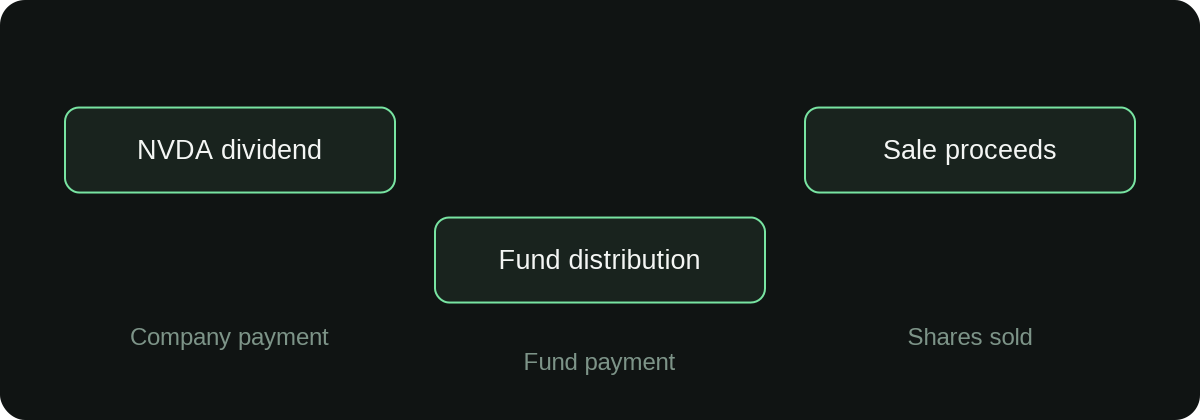
NVIDIA’s corporate dividend belongs to the company’s shareholder distribution process. NVDL’s shareholder distribution belongs to the fund’s own income, gains and tax framework. Your proceeds from selling NVDL shares are a third category altogether.
The daily leverage objective concerns the fund’s specified exposure to the underlying stock’s performance. It does not require a cash payment equal to twice the dividend on a direct NVIDIA holding. Derivative economics inside the fund are not the same as a direct shareholder dividend entitlement.
Similarly, selling some ETF shares to fund spending is a liquidation of part of the investment, not a fund dividend. The distinction matters when evaluating whether a product provides sustainable income or whether spending is being financed by reducing capital.
Check every date in a declared distribution
A distribution notice normally distinguishes declaration, ex-distribution, record and payment dates. They answer different questions: when the payment was announced, when shares trade without entitlement, which holders qualify under the applicable settlement arrangements and when cash is expected to be paid.
Use the actual notice and broker treatment for eligibility. Do not infer the ex-date by counting backward from the payment date, and do not assume a generic historical calendar remains correct after market or corporate-action changes.
If an order is pending around the event, check how the broker handles price adjustments and time-in-force instructions. A distribution can also complicate a raw-price chart. The historical-price guide explains why price adjustments must be understood before interpreting an apparent decline.
Do not confuse a cash payment with a free return
A fund distribution generally removes value from the fund when it goes ex-distribution, all else equal. Other market movements can occur at the same time, so the observed market-price change need not equal the payment exactly.
For a hypothetical illustration, a position worth $1,000 before a $50 cash distribution could have approximately $950 of remaining fund value plus $50 cash immediately afterward if nothing else changed. The payment has changed the form of value, not created a 5% profit out of nothing.
That illustration omits taxes, spreads and market changes. Buying immediately before a distribution solely to “capture” it is not a guaranteed gain. The investor may also acquire a taxable payment without the full economic history that generated it.
Read a yield measure before comparing it
A trailing distribution rate uses past payments and a stated price or NAV denominator. An annualized figure can extrapolate a recent payment. A standardized yield follows its own methodology. These are not interchangeable descriptions of future cash income.
Check the measurement period, whether special distributions are included and whether the denominator is current. A high percentage caused partly by a falling share price does not establish a healthier investment. A zero or unavailable field can also reflect the provider’s data coverage rather than a definitive forecast.
NVDL’s primary task is daily leveraged exposure, not a promised income target. Compare any income objective with that design before choosing the product. The retirement-portfolio article examines why uncertain payments and concentrated drawdowns can conflict with scheduled spending.
Preserve the tax classification separately
A payment may contain ordinary income, capital gains or other categories reported under the fund’s tax process. The final tax character is not settled by the word “dividend” in a quote application. Use the year-end reporting and any subsequent corrections.
The IRS mutual-fund distribution guidance explains why distribution categories can differ from the holding period of your own shares. Reinvestment does not automatically prevent taxation in a taxable account, and a tax-advantaged account follows different withdrawal rules.
For publication, keep the verified historical statement, declared future notice and tax classification in separate fields. That structure answers the income question without turning missing data into a fabricated yield or presenting a past fiscal year as a permanent rule.
Frequently asked questions
Will a reinvestment program buy shares at the ex-date price?
Not necessarily. Execution timing, price and fractional treatment depend on the broker’s program. Read the reinvestment terms and confirm the actual purchase record instead of assuming a particular chart price applies.
Why can two websites show different trailing yields?
They may use different price dates, measurement windows, corporate-action adjustments or payment datasets. Compare their definitions and source dates before deciding one figure represents a current cash promise.
Do I lose a declared payment if I transfer the shares between brokers?
Entitlement and processing can depend on the event dates and transfer status. Ask both firms how a pending payment will be credited, and reconcile the resulting cash record rather than assuming the receiving account gets it immediately.