 NVDL
The most useful NVDL mistake review separates an incorrect market view from an incorrect process. A losing trade can follow a correctly executed plan, while a profitable trade can conceal oversized exposure, mistaken order terms or a misunderstanding of daily leverage.
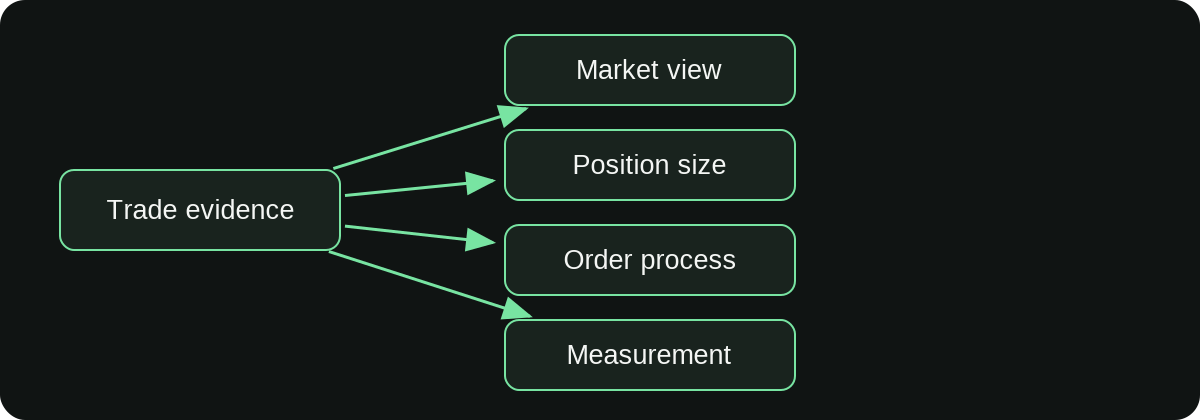
Start with evidence: the original plan, order confirmations, fills, source timestamps and account records. Reviewing only the final profit number encourages hindsight. The goal is to identify an error you can actually correct before taking the next position.
Mistake: sizing by share count rather than dollars
A trader may buy the same number of NVDL shares as a prior NVDA holding and assume the exposure is similar. Different prices and a daily leveraged objective make that comparison unreliable. Splits can change share counts again without changing economic value by themselves.
The correction is to calculate position value, the intended exposure and the dollar effect of adverse scenarios before submission. Include other NVIDIA-sensitive assets in the account. A small-looking share count can still create a substantial concentrated risk relative to available savings.
The fund objective establishes what the product seeks; the scenario worksheet helps translate assumptions into dollars. Neither supplies a universally appropriate position size. That decision requires the investor’s actual financial constraints.
Mistake: changing the horizon only after a loss
A short event trade can become an indefinite holding when the trader refuses to realize a decline. The new plan may have no review date, no remaining business rationale and no analysis of daily compounding over the extended period.
Compare the entry reason with the current reason in writing. If the latter is only “get back to my purchase price,” the position has lost its forward-looking decision rule. Recovery is a possible outcome, not evidence that continued leveraged exposure is the best available choice.
The correction is not an automatic sale after every losing day. It is a fresh decision about the remaining capital and the task it should serve. Preserve the distinction between a measured longer-horizon plan and an unplanned refusal to reassess.
Mistake: treating an accepted instruction as a completed trade
An order can be working, partially filled, rejected or awaiting cancellation. A screen confirming submission does not prove the intended number of shares was bought or sold. A partial exit leaves exposure that can be overlooked overnight.
Reconcile executed quantity with remaining quantity and inspect other pending orders before submitting a replacement. An independent second exit can conflict with the first. If linked instructions are supported, verify their behavior rather than assuming every broker uses the same arrangement.
The SEC order guide distinguishes order conditions, but the broker determines the available implementation. Preserve order identifiers and statuses. This makes it possible to investigate an execution problem without reconstructing events from memory.
Mistake: relying on a stop outside its operating conditions
A trader can set a stop in one session and assume it protects a position throughout the night. Another may treat the trigger as the guaranteed price received. Both assumptions can fail even if the broker processes the instruction according to its terms.
Record the trigger basis, active session, time in force and treatment of a gap. A stop-market and stop-limit solve different problems. The SEC stop bulletin explains why one can execute at an unexpected price while the other may remain unfilled.
The corrective action is to reduce dependence on an unverified order guarantee. Test the plan against a worse executable price and an unavailable market. An alert or a smaller position can help with a particular constraint, but neither creates insurance against every adverse event.
Mistake: explaining every performance gap with one word
“Decay” is sometimes used for any result that looks worse than twice a chart’s NVIDIA change. The actual issue might be mismatched times, a distribution adjustment, different starting prices, trading friction or fund costs, in addition to genuine path dependence.
Align the series and interval first. Then distinguish the daily-reset mechanism from expenses and your own executions. If data is missing, label the attribution incomplete rather than filling the gap with a confident single-cause explanation.
The mathematical guide isolates a true round-trip effect. It does not prove that the same mechanism explains every observed discrepancy. A diagnosis requires the actual inputs for the specific holding being reviewed.
Mistake: mistaking a result for evidence of skill
A profitable trade after a rumor does not validate the rumor or show that the entry process is repeatable. Likewise, a short sample of winning days does not establish the probability of future gains. The assessment needs the decisions and information available before the outcome.
Keep a journal with the original source, the decision time, what would invalidate the view and the action taken. Avoid rewriting the entry explanation after reading later news. If an assumption was wrong but the trade made money, retain both facts.
Evaluate costs and losses across the full set of trades. Selecting only memorable winners can hide repeated small execution losses or a single large drawdown. No performance claim should be based on a selectively displayed account screenshot.
Turn the review into a specific process change
For each error, name the failed assumption, supporting record, corrective step and next check. “Be more careful” is too vague. “Verify session eligibility and order state before carrying shares overnight” identifies a task that can be observed.
Prioritize a control you can implement consistently. Adding many alerts or indicators can make a process harder to follow without fixing its main weakness. If the underlying problem is a mismatch with your finances or monitoring ability, another chart overlay will not resolve it.
The review can end with a decision not to repeat the product or strategy. That is a valid finding, not evidence that every market movement must be predicted more accurately. A trade should serve a defined purpose under realistic constraints, rather than become an obligation to recover a previous loss.
Frequently asked questions
How many trades are enough to prove my revised rule works?
There is no universal count that guarantees a valid conclusion. Market regimes, sample selection, dependence between trades and execution assumptions all matter. A small favorable sample should not be promoted as a reliable strategy record.
Should I delete bad trades from a practice journal?
Keep them with clear labels. Removing mistakes can erase the evidence needed to improve the process. If a simulation produced unrealistic fills, flag that limitation instead of treating the resulting return as a genuine performance record.
When is a broker complaint different from a trading loss?
A complaint concerns a specific alleged service or execution issue supported by records. A market moving against a correctly processed order is not automatically misconduct. Preserve documentation and use the broker’s formal process for unresolved discrepancies.