 NVDL
You cannot disable NVDL’s path dependence while holding the fund. You can change how much you hold, how long you remain exposed and how you review the position, but none of those choices guarantees that volatility-related losses disappear.
The phrase “avoid volatility decay” often invites a shortcut: buy only on certain days, sell at a preset hour or switch tickers after a loss. A useful plan instead identifies which risk each action addresses and what remains outside your control. This article concerns the management decision; the separate mathematical guide explains the compounding calculation.
Identify the problem before selecting a remedy
Volatility-related compounding effects, fund expenses and execution costs are different sources of performance differences. A wider bid-ask spread is not the same mechanism as applying a leveraged loss to a balance changed by yesterday’s gain.
The SEC’s leveraged-ETF discussion explains why returns over longer periods can differ from the stated daily multiple. The NVDL prospectus adds the fund’s own operating conditions. Neither establishes a fixed daily penalty that you can cancel by trading at a particular minute.
Start by recording the actual problem: an unexpected multi-day return, an expensive fill, an overnight gap or an account financing charge. If you cannot distinguish those causes, changing the holding period alone may leave the main source of loss untouched.
Shorten exposure only when it fits the task
A shorter holding period reduces the number of daily compounding steps included in the position. It does not ensure a favorable move within the remaining interval. A short trade can still lose substantially, and an intraday purchase does not automatically receive exactly twice NVIDIA’s subsequent intraday movement.
State the task in advance: the event or market condition being traded, the intended review time and the condition that ends the position. If the original task requires years of business ownership, constantly recreating short leveraged trades may be an unsuitable way to accomplish it.
Avoid a rule that automatically extends the holding period whenever the position loses. Such a rule lets the entry price control the plan while ignoring whether the original reason still exists. The review should evaluate current exposure, not merely the desire to recover a prior balance.
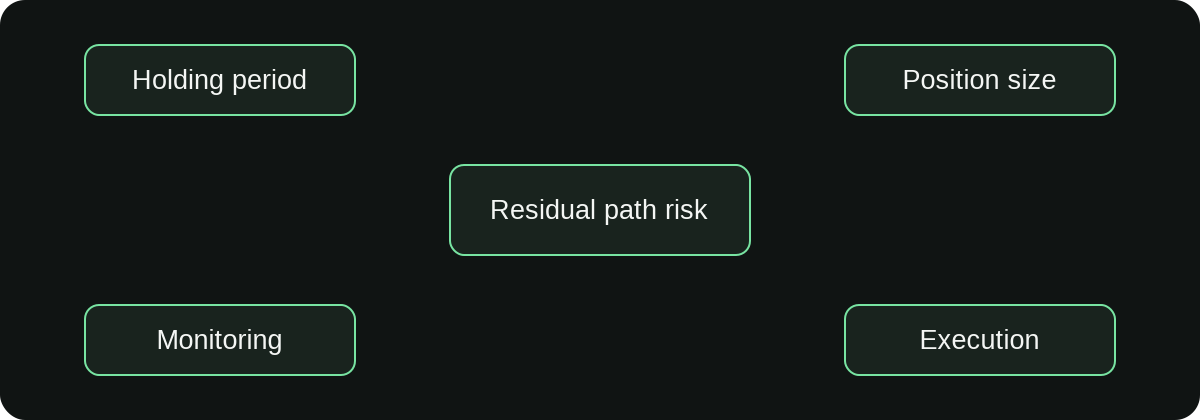
Reduce dollar exposure without claiming better percentage returns
Position size changes the amount at risk. A smaller holding can make the same adverse percentage path less damaging to the account, but it does not improve that path or remove fund-level compounding.
Measure the position alongside other NVIDIA-sensitive holdings. Direct NVDA shares, semiconductor funds, employer stock and options may create overlapping economic exposure. Several tickers do not guarantee diversification when their main risk driver is similar.
Do not offset a concern about decay by borrowing more to target the original desired dollar profit. That can add account-level interest and financing constraints to an already leveraged instrument. Any comparison should assess the entire account’s exposure and obligations rather than only the number of NVDL shares.
Give monitoring a specific action
A useful monitoring rule says what evidence you will check, when you will check it and what decision it can change. “Watch closely” is not enough if the relevant news arrives during work, travel or a market closure.
Use price alerts as prompts to review the position, not as automatic protection. Verify delivery settings and recognize that responding requires available market access. If you cannot act during the meaningful window, the monitoring plan contains a practical gap.
The overnight checklist addresses session access and unfilled exits. Its role is to make the exposure visible. No checklist can guarantee that the next executable market price stays within a planned loss amount.
Consider the cost of repeated exits and reentries
Closing before each regular-session end can avoid carrying that particular position into the next ordinary session. It can also realize losses, miss overnight gains and generate additional spreads, fees or tax consequences. The trade-off cannot be evaluated using the fund’s expense ratio alone.
Compare a proposed rule using consistent, adjusted prices and plausible execution assumptions. Include unfilled limits and the treatment of gaps rather than assuming frictionless trades at every closing price. If a historical test selects its rule after seeing the results, describe that hindsight limitation.
A backtest is not presented here because no complete execution dataset or validated strategy has been supplied. A hypothetical illustration can teach the mechanism, but it cannot establish that frequent trading reliably outperforms holding the underlying stock or remaining uninvested.
Choose an alternative by the exposure you need
If the task is long-term participation in NVIDIA’s business, compare direct shares with the extra demands of a daily leveraged fund. Direct shares retain substantial company risk, but they do not have the ETF’s daily-2x objective. A broader fund changes the concentration question as well as the leverage question.
If the task is a short directional view, assess whether you understand and can fund the potential losses without relying on an emergency exit. Another leveraged ETF with the same underlying and daily target will still have path dependence; a different ticker is not a cure.
Use the peer-comparison framework to separate costs and execution from exposure design. An option or inverse fund introduces different risks and should not be treated as a simple replacement that solves every problem.
Reassess the rule after the trade
Record why the position ended and whether execution matched the plan. Separate a losing market view from a failure of the order process. Both can matter, but they require different corrections.
A practical plan can improve consistency without improving the market’s future behavior. Keep that limit explicit when evaluating any technique advertised as decay-proof. The objective is to decide whether the residual risks remain acceptable for the actual task, not to relabel them as eliminated.
Frequently asked questions
Does buying after several down days avoid the compounding problem?
No. A prior decline does not establish the next return sequence or a guaranteed rebound. A rule based on recent losses needs independent evidence and risk analysis; the daily-reset mechanism still applies after the new purchase.
Can I remove path dependence by reinvesting every distribution?
Reinvestment changes the share count and belongs in a total-return calculation. It does not convert a daily leveraged objective into a fixed multiple of a long-term stock return. Costs and the future sequence remain relevant.
Would an automatic monthly purchase plan solve decay?
Recurring purchases create multiple entry dates and change the amount invested over time. Evaluate that cash-flow strategy separately from the fund’s return series. Regular contributions cannot guarantee profit or make a daily leveraged fund appropriate for an otherwise unsuitable horizon.