 NVDL
Trading NVDL around Jensen Huang news combines company-catalyst risk with daily leverage, execution uncertainty and a changing return path. A confirmed announcement can still lead to a losing trade, especially if the entry follows a large gap or the position remains open through reversals.
The risk review should follow the position through time: before the announcement, when the information becomes public, during the first tradable response and across later closes. Each stage creates a different failure mode. One stop order or a bullish headline cannot address all of them.
Before the event: identify the exposure being carried
Confirm the filled quantity, pending orders and total NVIDIA-sensitive exposure. A purchase awaiting execution is not the same as an existing position, and a partially completed exit can leave more risk than expected. Use confirmations rather than the original ticket amount.
Then identify what the event is expected to change. A scheduled keynote and an unscheduled leadership announcement have different timing and information risks. A calendar can organize known events, but it cannot guarantee that the material statement arrives only during the planned window.
NVDL’s prospectus defines the leveraged product and its loss risks. The investor’s catalyst plan should be tested against that structure, not built on the assumption that a prominent speaker makes a short position automatically manageable.
At publication: separate authenticity from favorable interpretation
Verify the original source and preserve the public timestamp. A genuine company announcement can still contain forward-looking statements or qualifications. Authenticity establishes where the words came from; it does not establish that the optimistic interpretation will be realized.
Avoid increasing the order because several social accounts repeat the same headline. They may all depend on one source or omit the same caveat. A correction or clarification can arrive after the first market response.
The announcement framework distinguishes product, availability, financial and governance content. Use the relevant category to identify what evidence matters next instead of treating every favorable mention as independent confirmation.
At entry: stress a gap and a worse executable price
The market may have repriced before the order reaches an available venue. A previous close, a quote midpoint and the reported opening print are different references. None guarantees that the investor can transact the intended quantity there.
Compare the actual bid, ask and supported session with the planned entry. A limit constrains acceptable price but can remain unfilled; a market instruction can encounter changing levels. The SEC order explanation provides the basic trade-off without promising a perfect implementation.
If the thesis depends on entering before a public repricing, an order placed afterward serves a different trade. Recognize that change explicitly rather than preserving the original expected gain while paying a new, much higher price.
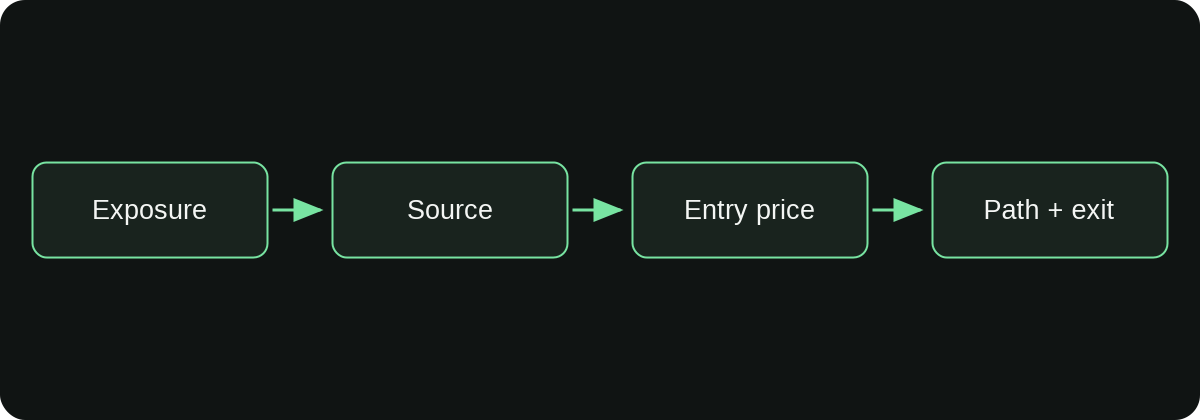
Across closes: test reversal rather than only the first jump
Consider a hypothetical stock path of +15% followed by −15%. Starting at 100, the stock model ends at 97.75. An idealized daily-2x model goes to 130 and then 91, because the second −30% applies to the changed balance.
This is not an observed Huang-event return or a forecast of a particular catalyst. It isolates one path risk that an initial gain can obscure. A large first-day profit does not immunize the position against the next daily move.
Do not describe the difference as a fixed amount the fund removes each evening. Compounding depends on the sequence, while implementation costs are separate. The mathematical article explains the mechanism and its domain.
When the exit fails: know what remains uncontrolled
A stop-market order can execute beyond its trigger after a gap. A stop-limit may remain unfilled. An instruction restricted to one session can be inactive while news is changing expectations elsewhere. Review those conditions before treating a planned stop amount as a maximum possible loss.
The SEC stop-order bulletin explains the distinction. A smaller position can reduce the dollar consequences of a given move, but it cannot remove the price gap. An alert can prompt action, but it cannot create liquidity or force the phone notification to arrive before the market changes.
If trading is interrupted, inspect the broker’s handling of pending orders and the next available session. Do not stack new instructions without reconciling existing ones. A reaction intended to restore control can create a second unintended transaction.
Use a stage-by-stage risk record
A useful record identifies the assumption, failure condition and response for each stage. The response should be practical under actual account permissions and monitoring capacity, not dependent on continuous access that has not been verified.
| Stage | Failure condition to test | Record to preserve |
|---|---|---|
| Before news | Incorrect filled quantity or hidden overlap | Positions and open orders |
| At publication | Old, incomplete or corrected statement | Original source and timestamp |
| At entry | Gap, spread change or unfilled limit | Quote context and execution |
| Across days | Reversal and changed compounding base | Daily path and review decisions |
| At exit | Inactive trigger or incomplete sale | Order status and residual shares |
This is a control framework, not a trading system with a proven win rate. If the response cannot be carried out consistently, revise the exposure rather than describing the missing capability as a minor inconvenience.
Review the trade without rewarding a broken process
A profitable outcome does not prove that an oversized or incorrectly timed entry was sound. A loss does not automatically show that the announcement was false. Compare the result with the information and operating conditions available when the decision was made.
The November return case shows why a large daily rally and a later buyer’s result can differ. Treat it as evidence about measurement and execution, not as a promise that the next leadership or product catalyst will repeat the same path.
Frequently asked questions
Can holding an inverse ETF alongside NVDL remove this catalyst risk?
Not automatically. Daily targets, changing values, costs and hedge proportions can drift across periods. A combined position needs its own analysis rather than an assumption that opposite labels cancel every future outcome.
Does canceling an entry after a headline correction guarantee no exposure?
No. The order may have filled or partially filled before cancellation completes. Confirm the broker’s final state and reconcile the actual holdings before assuming the account remained uninvested.
Should I preserve a rumor that turned out to be wrong in my records?
Yes, if it influenced the decision. Mark it as corrected or unsupported and record when better evidence arrived. Removing it can hide the source-quality failure that the review should address.